We should copy New Zealand's malpractice policy
Get Out-Of-Pocket in your email
Looking to hire the best talent in healthcare? Check out the OOP Talent Collective - where vetted candidates are looking for their next gig. Learn more here or check it out yourself.
 Hire from the Out-Of-Pocket talent collective
Healthcare 101 Crash Course
%2520(1).gif)
Featured Jobs
Finance Associate - Spark Advisors
- Spark Advisors helps seniors enroll in Medicare and understand their benefits by monitoring coverage, figuring out the right benefits, and deal with insurance issues. They're hiring a finance associate.
- firsthand is building technology and services to dramatically change the lives of those with serious mental illness who have fallen through the gaps in the safety net. They are hiring a data engineer to build first of its kind infrastructure to empower their peer-led care team.
- J2 Health brings together best in class data and purpose built software to enable healthcare organizations to optimize provider network performance. They're hiring a data scientist.
Looking for a job in health tech? Check out the other awesome healthcare jobs on the job board + give your preferences to get alerted to new postings.
This episode of Out-Of-Pocket is brought to you by...

If you run an MSK practice, you already know where your patients go missing. It's the fax machine pileup, the voicemail box, the post-op follow-up nobody made, and the auth that sat until it didn't matter. Flagler is the operating system for all of it. Referral intake, scheduling and call center AI agents, patient engagement, care management, RCM. Practices see 32% fewer no-shows and an average $164K revenue increase per provider.
—
Maybe...a doctor should comment on malpractice?
I wrote a few pieces about how I think malpractice is changing drastically thanks to AI and changes in how we think about the standard of care. Bangers, you're missing out if you haven't read them.
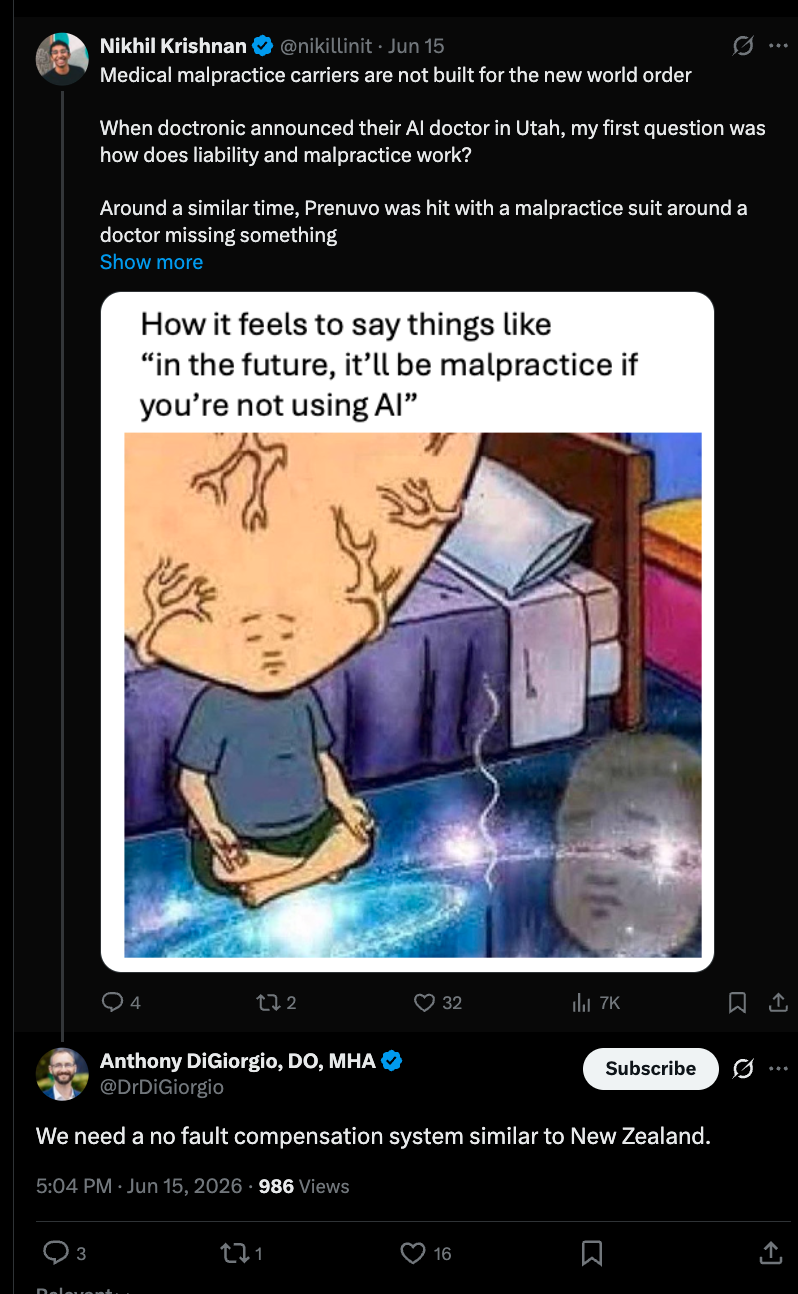
Dr. Anthony DiGiorgio, a neurosurgeon, responded that we should adopt a malpractice policy more like New Zealand. So I thought it would be fun to have him guest post about his thoughts on malpractice in the US today + how it could be improved.
Two quick things before we get into the post that you might like.
Have you heard of AGENTS??? And that they can be used in HEALTHCARE OPS??? Well if that sounds interesting you should come to our free AI Agents in Ops course we're doing on 10/27 - 10/29 with Champ. Aren't you just CHAMPING AT THE BIT.

And don't forget, if you're thinking about your next job you should come talk to us. We'll keep you anonymous in your search and just give you a sense of what's out there.
Especially if you're an engineer even if outside healthcare, or a healthcare ops leader.

Okay then. Below is a guest post from Dr. Anthony DiGiorgio. Memes, charts, and comments from me.
No Fault New Zealand
Dr. Anthony DiGiorgio (X, Substack)
Imagine a neurosurgeon removing a large tumor at the base of a patient's skull. The tumor is pressed against the brainstem and intertwined with the facial nerve, which controls the muscles responsible for closing the eye, smiling, and moving one side of the face. The operation lasts fourteen hours. The neurosurgeon works millimeter by millimeter, trying to separate the tumor from structures that control consciousness, breathing, swallowing, and facial movement. Despite those efforts, the patient wakes up with complete facial paralysis.
The harm is undeniable. The patient cannot close one eye and may require years of eye care. They are disfigured. Yet the legal meaning of that harm is much less certain. Was the nerve injured because the surgeon was careless, or was the anatomy so unforgiving that facial paralysis could not reasonably have been avoided? Was this negligence, a systems failure, or simply an expected complication of treating a dangerous tumor?
The patient and family reasonably want three things: an honest explanation, accountability if someone did something wrong, and help managing the consequences of the injury.
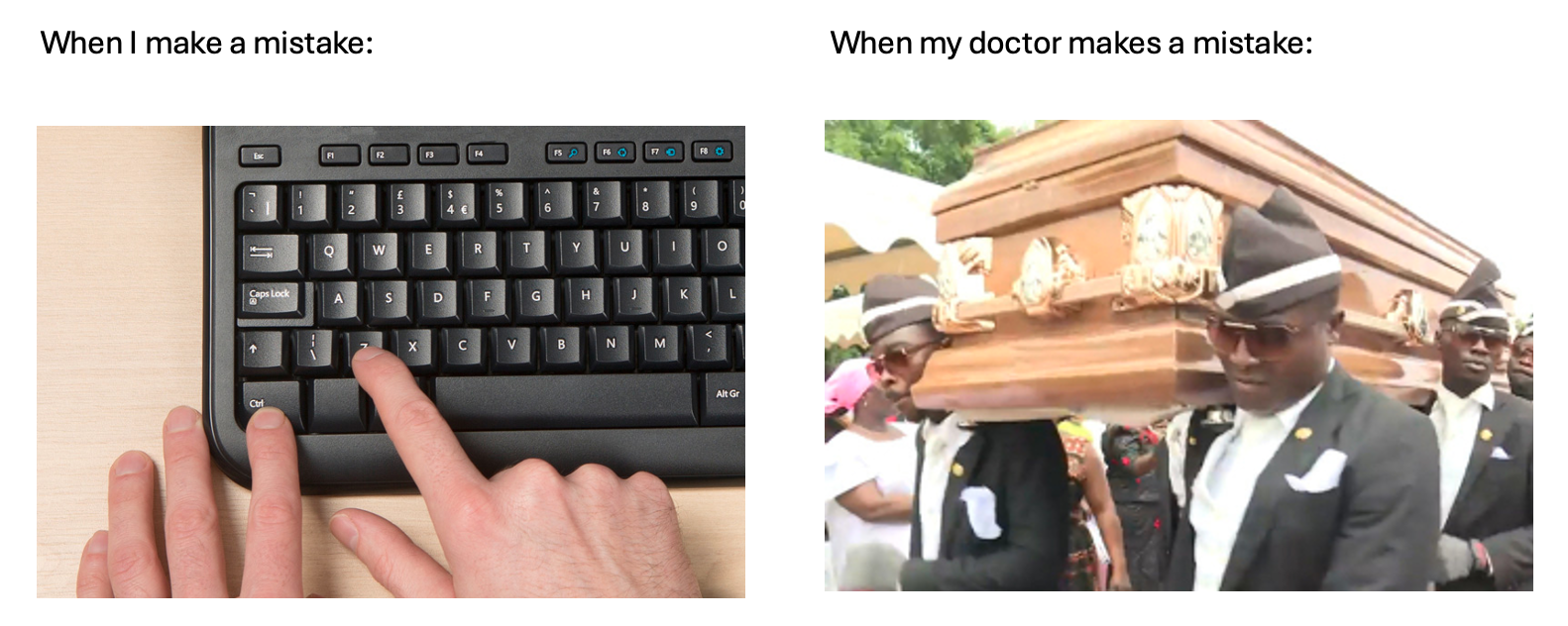
What does malpractice solve for and what does it cost us?
Our current malpractice system does a poor job of delivering any of them. Instead, it converts the injury into a lawsuit and asks
- Whether a lawyer can prove that a clinician breached the standard of care
- That the breach caused the injury and damages resulted
- That the damages are large enough to justify years of litigation.
In a case like this, the injury may be obvious while negligence and causation remain deeply contested. Expert witnesses will review the same operation and reach different conclusions. One will say that the surgeon should have stopped earlier. Another will say that leaving the tumor behind would have been negligent.
Years may pass before the patient receives anything. Many cases settle without establishing that negligence occurred because both sides are buying protection from an uncertain verdict. Other patients with legitimate injuries may never find a lawyer because the expected damages are too small to justify the cost of experts and litigation. A dangerous physician may escape accountability because no patient files a viable claim, while a careful physician may spend years defending an unavoidable complication.
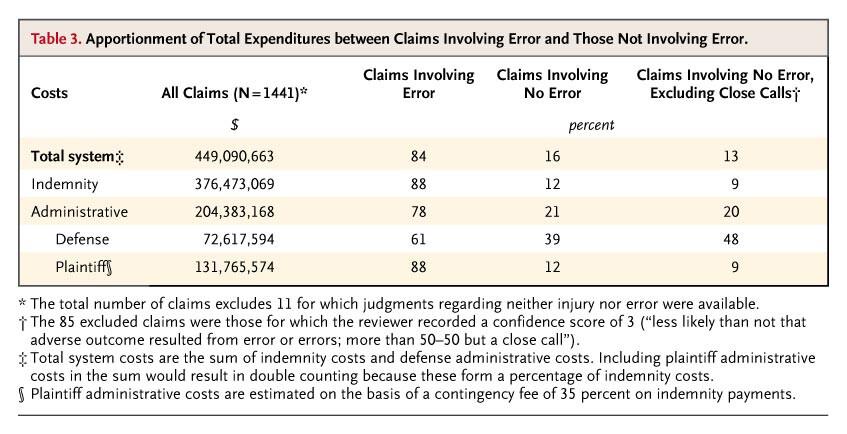
The transaction costs are enormous. In one major study of 1,452 closed malpractice claims, 54 cents went to administrative expenses for every dollar paid in compensation, including the costs of lawyers, experts, and courts. The same study found that claims without evidence of error were not uncommon but usually did not receive compensation. The larger problem was the expense of determining which claims deserved payment at all.
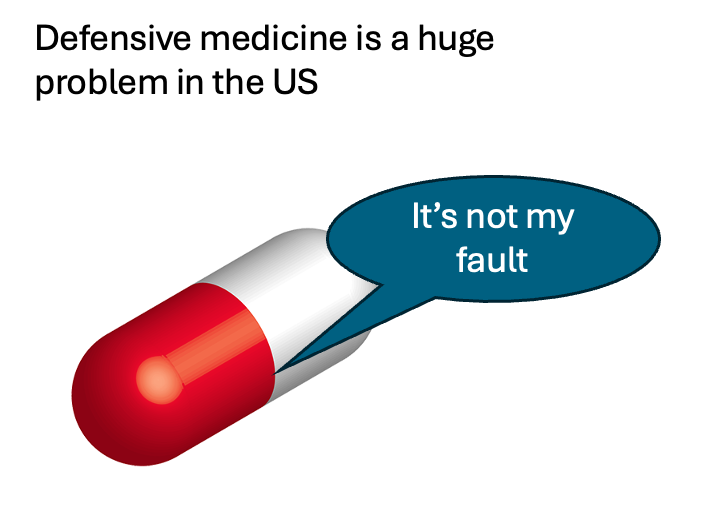
The malpractice system leads to “defensive medicine.” Physicians order extra tests, obtain extra consultations, preemptively document as if they are defending themselves in court, and sometimes avoid the highest-risk patients. One analysis from 2010 estimated the entire medical liability system at $55.6 billion, or 2.4 percent of healthcare spending, with $45.6 billion attributed to defensive medicine. Those numbers are undoubtedly larger now.
As a neurosurgeon, I live with these realities daily. A terrible outcome does not necessarily mean the operation was performed badly, just as a good outcome does not prove that it was performed well. Patients have complex biology and bring preexisting problems to any encounter. The tort system tries to force this uncertainty into a binary verdict: someone was legally at fault, or no compensation is owed.
That is a strange way to provide insurance against medical injury.
In our example, the patient's new injury-related needs exist whether the surgeon was negligent or not. At the same time, the question of whether the surgeon is competent to continue operating should not depend on whether a plaintiff's lawyer believes the damages are large enough to pursue. Compensation and professional discipline are different functions. Yet we have combined them into a system that does neither well.
There's a better way: a no-fault system.
Out-Of-Pocket is also supported by...

What is a no-fault system?
This would separate the functions of compensation and discipline. The closest familiar American analogy is workers' compensation. A worker injured on the job can receive medical treatment, wage replacement, vocational rehabilitation, and other defined benefits without first winning a personal-injury lawsuit against the employer. In return, the worker generally gives up the opportunity to pursue unrestricted tort damages for the covered injury.
The term “no-fault” is easy to misunderstand. Causation and eligibility still matter. A worker must show that an injury arose from work. What disappears is the requirement to prove that an individual employer committed negligence before compensation becomes available.
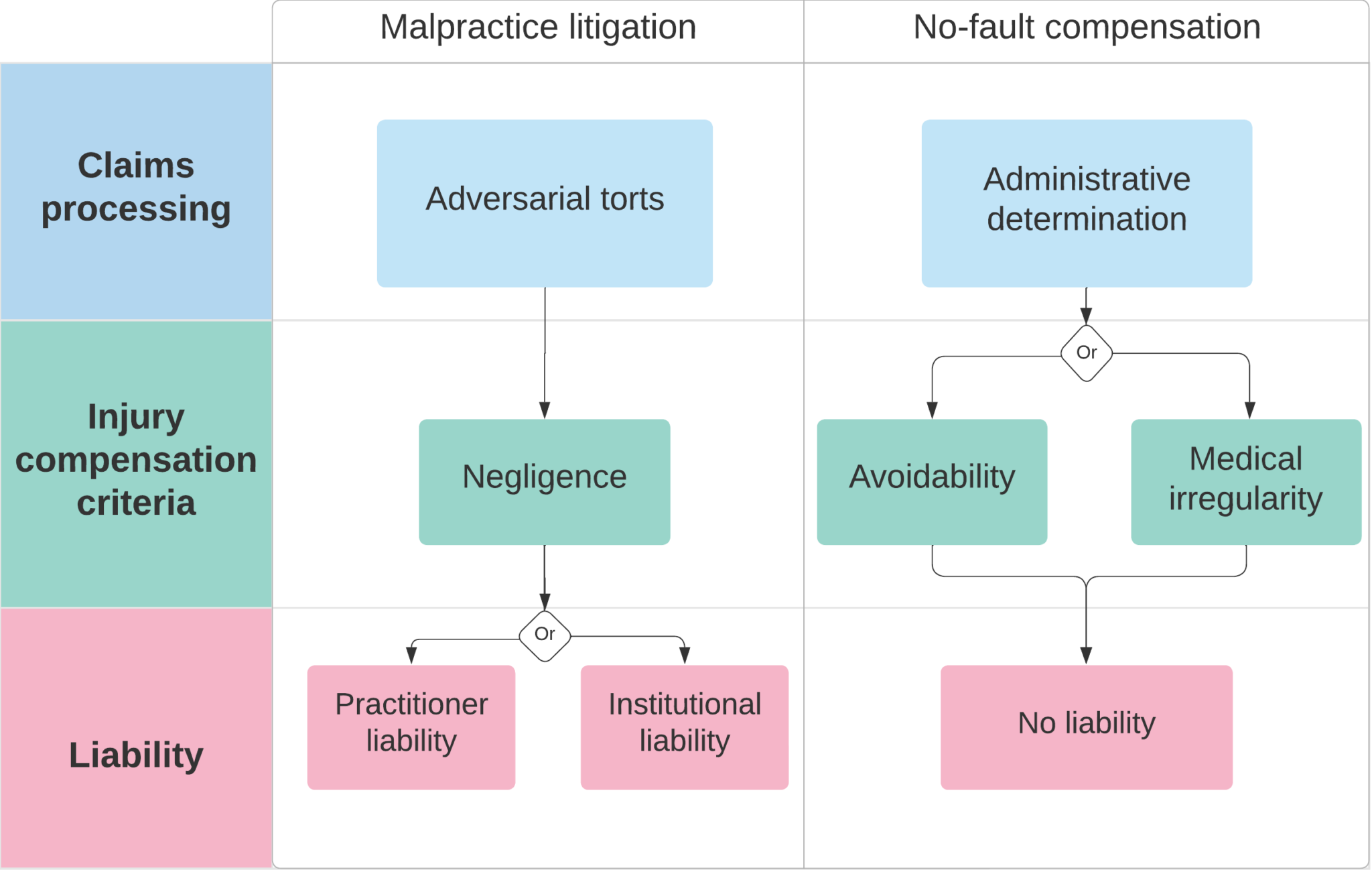
New Zealand provides the broadest working example. Its Accident Compensation Corporation operates a national no-fault injury system covering residents and visitors.
For medical care, ACC can cover a “treatment injury” when treatment directly causes physical harm. ACC considers the available clinical knowledge, the patient's underlying condition, and the circumstances in which treatment was delivered. Covered patients can receive help with medical treatment, rehabilitation, equipment, and home support, as well as lost income, including weekly compensation of up to 80 percent of prior earnings.
In exchange, New Zealand generally bars lawsuits seeking compensatory damages for personal injuries covered by ACC, although limited claims for exemplary damages remain possible in particularly egregious circumstances.
Our brain tumor patient would not automatically receive compensation in New Zealand. The question would be whether the facial paralysis was an ordinary consequence of an exceptionally difficult operation, considering the tumor's relationship to the facial nerve and the state of medical knowledge. A known risk is not automatically an ordinary consequence, but neither does disclosure of a risk transform every resulting injury into a compensable event. The system still has to draw a line.
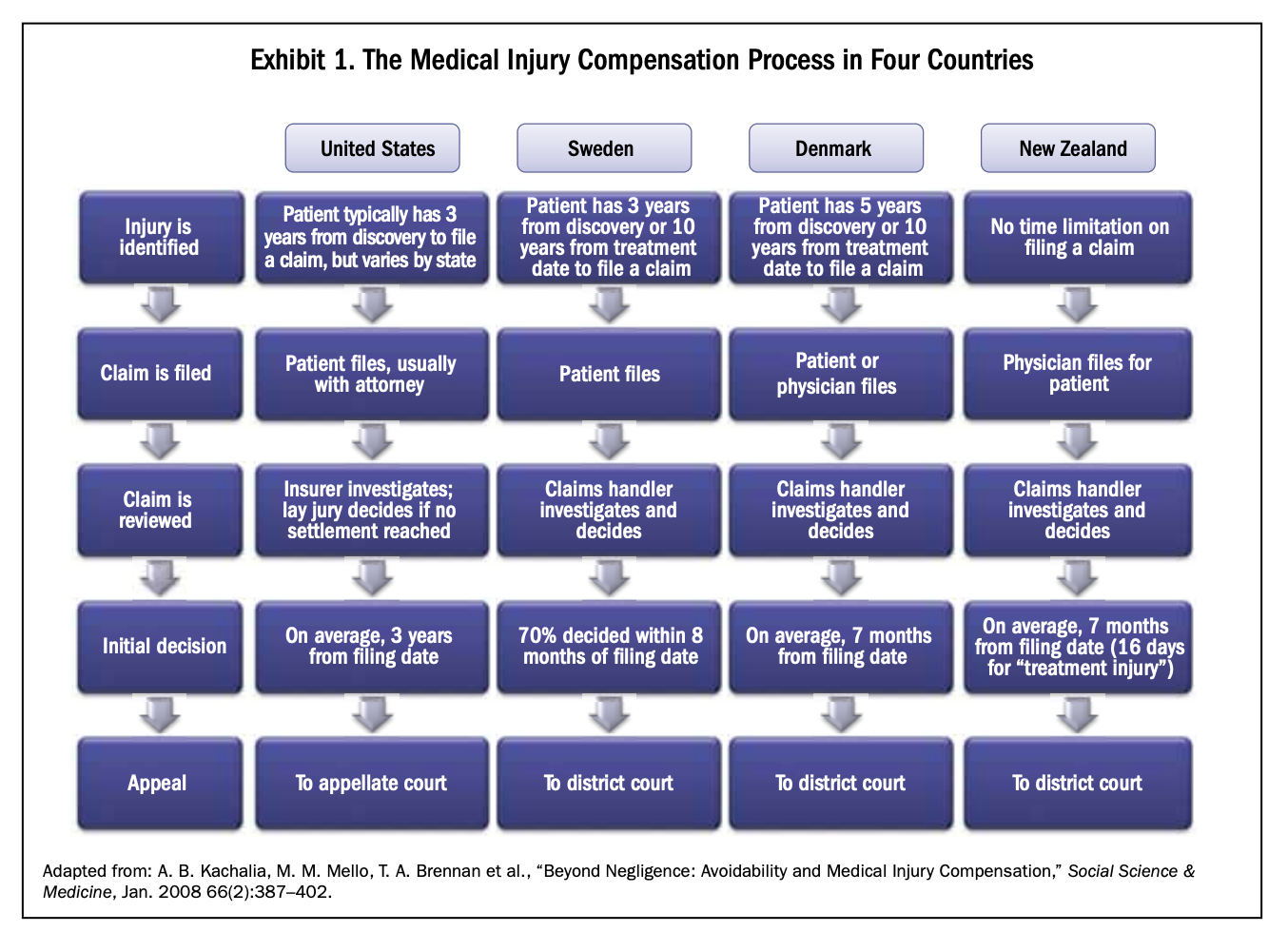
Sweden and Denmark offer useful examples as well. Patients can file a medical injury claim without an attorney, and neutral medical experts review the claim. Compensation is awarded without proof of negligence, just that there was an avoidable medical injury. They have various legal standards as to the “reasonableness” of the injury and compensate accordingly.
Aside from workers' compensation, the US has a few other examples of no-fault systems in healthcare. The National Vaccine Injury Compensation Program is a no-fault alternative to ordinary vaccine litigation. The process is hardly bureaucracy-free, but it uses a different evidentiary structure. When an injury appears on the Vaccine Injury Table and begins within the specified period, causation is presumed unless another cause is demonstrated. The patient is compensated.
Florida offers another domestic example. Its Birth-Related Neurological Injury Compensation Plan was created during a malpractice insurance crisis that threatened access to obstetrical care. The statute provides compensation “irrespective of fault” for a limited category of catastrophic birth-related injuries. For covered claims, the plan is generally the exclusive remedy, with exceptions for bad faith, malicious conduct, or willful and wanton disregard for safety.
These programs demonstrate that no-fault compensation is not foreign to American law. We have adopted it when ordinary tort litigation threatened the availability of socially valuable services or products.
How could this work today in the US
A workable American system should probably begin at the state level. States already regulate medical malpractice, professional licensure, and much of the insurance market.
The first requirement would be a meaningful severity threshold. A table of clearly compensable events could provide presumptive payment. A wrong-site surgery or retained foreign object is pretty simple to adjudicate. More complicated cases would go to neutral specialty reviewers.
The benefits would also need to be explicit.
- Compensation would be paid according to a schedule: uncovered medical expenses, rehabilitation, lost wages, long-term care, disability support, and a capped non-economic payment for severe injury.
- Existing health insurance and disability benefits would have to be coordinated with the fund so that the same expenses were not paid twice.
- Gross negligence, intentional misconduct, and willful disregard for patient safety should remain outside the safe harbor.
Accountability would remain essential, but not every compensated injury should automatically become a disciplinary case. Compensation records should feed a patient-safety database capable of identifying recurring problems, and the fund would work closely with state licensure boards.
This no-fault compensation should reduce legal expenses and may reduce some defensive medicine. It would also make compensation available to patients whose claims are insufficiently lucrative for the tort system. A well-designed no-fault system might lower transaction costs while paying more injured patients. Its net savings could therefore be small.
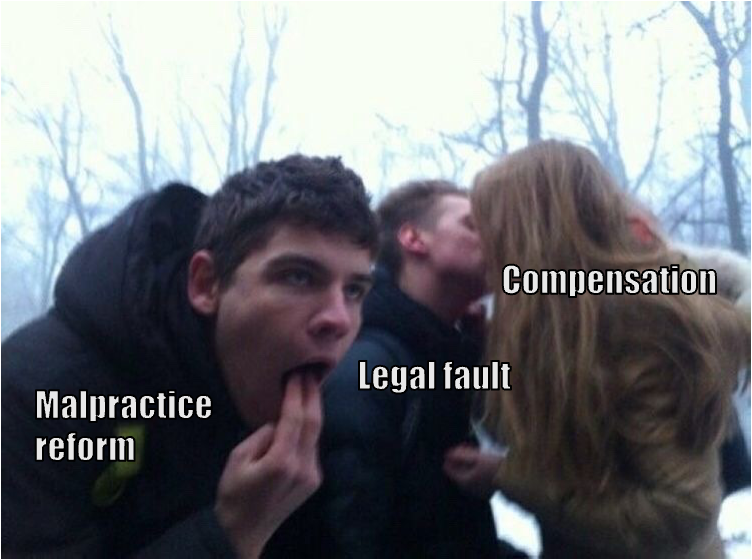
No system will be perfect at punishing negligence and compensating injuries. It need not be perfect to improve on our current system, which does neither well.
Some commentary from Nikhil
Boomer voice: “how do I get my wife to agree to one of these no fault systems guffaw guffaw guffaw”.
Anyway I think this is an interesting proposal. It does seem like most people are unhappy with the current malpractice system, especially doctors. I went down rabbitholes reading after this.
First, it's surprising how hard it is to find up to date studies on malpractice. A big part of this is data access. The National Practitioner Data Bank is public but only records paid claims and has no clinical detail which makes it pretty unhelpful. Malpractice carriers seem to only give researchers access to their internal claims when the industry is going through some kind of crisis. The 2006 Studdert paper had 5 malpractice carriers give rawdogged claims access to the researchers, which doesn't really seem to happen ever.
Our system also creates an added issue that there really isn't a central repository to analyze claims, it's scattered across the carriers. Other countries collate it all into one place so you can actually use it for safety research + look deeper into doctors/institutions that might have more issues.
Second, there's always been the question of whether malpractice liability improves outcomes if doctors do more to avoid mistakes. Meta-analyses suggest no.
The extended question is whether defensive medicine is real? The most interesting paper here IMO was one that looked at military health members - active duty military can't sue for malpractice while their dependents can. This creates a natural experiment, and the findings are that active duty members were consistently receiving less intensive health services. This suggests defensive medicine is in fact real - and talking to any doctor that's gone through a malpractice case before will basically confirm that for you.
And finally, do the other countries mentioned have less admin/payouts? The Commonwealth Fund paper is a bit old and does this analysis. The US has less claims but a much higher amount per claim, a generally more opaque process around appeals/success, and tends to have much higher administrative costs.
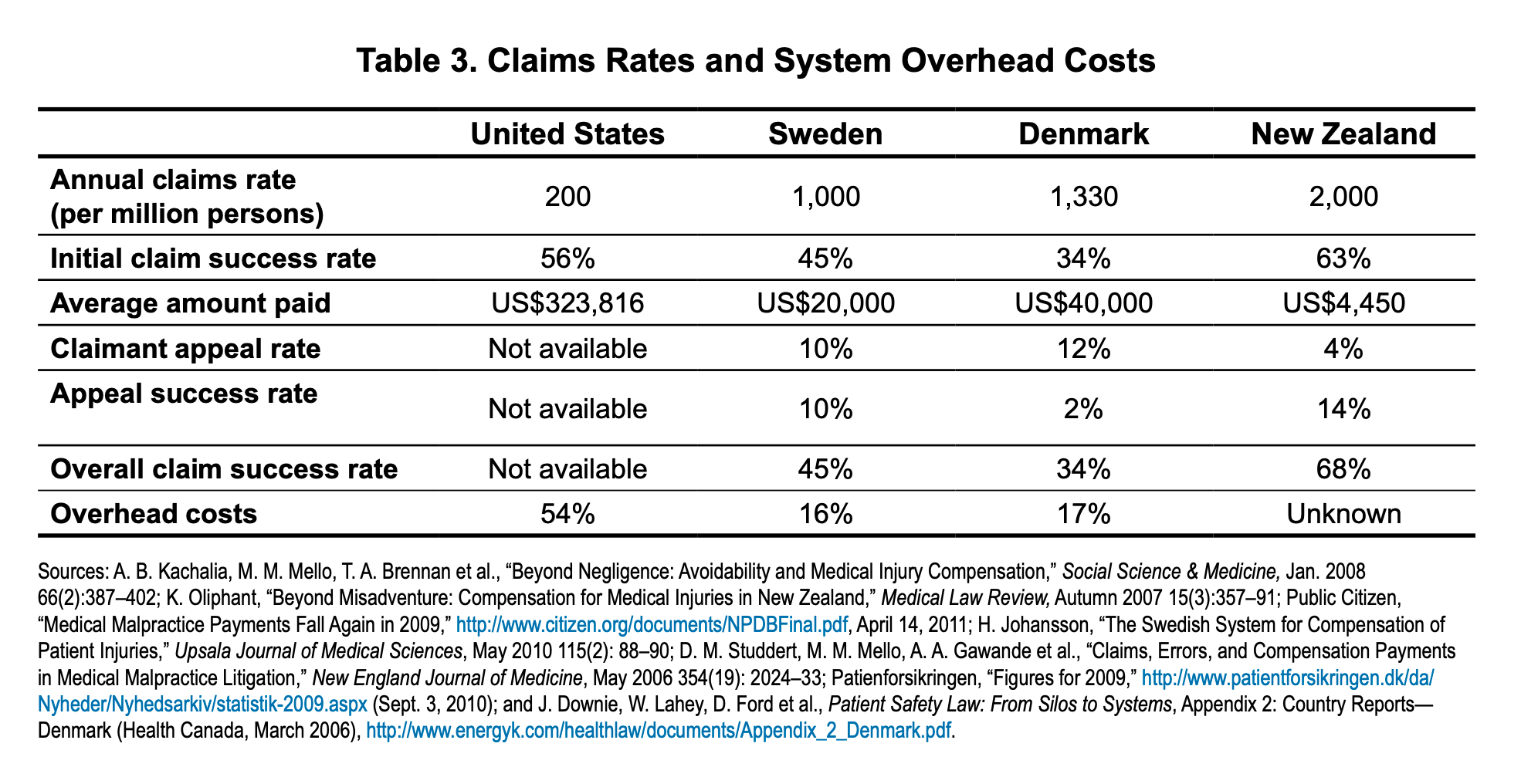
Curious what other people think about this proposal. I think it would depend on how the administrative determination works. Will everyone agree to the methodology that determines the cause of an injury? Will they agree on who the neutral experts are that do these reviews?
I do think it's worth trying to move to a system that incentivizes helping out more people with smaller claims vs. the pursuit of nuclear claims in the $20-$100M+ range.
Thinkboi out,
Nikhil aka “No Fault, Zone. No Fault, Zone”
Quick Interlude - “Am I a fit for Knowledgefest?”
See All Courses →Based on the questions I’m getting about Knowledgefest, I’m doing a really bad job explaining who should come.
The conference is for anyone building in healthcare.
- It is not specific to companies delivering patient care - Lots of people at software only, insurance, etc are coming.
- Any size of company can come - We have two person just out of YC companies, people that run ops at clinics, to F500 companies.
- You can be any role - Almost every role touches ops in some way. Product, founders, clinical, etc. should definitely come.
You should apply if you’re not sure, and we’ll let you know :)

Get Out-Of-Pocket in your email