Pregnancy taught me a lot about healthcare
Get Out-Of-Pocket in your email
Looking to hire the best talent in healthcare? Check out the OOP Talent Collective - where vetted candidates are looking for their next gig. Learn more here or check it out yourself.
 Hire from the Out-Of-Pocket talent collective
Healthcare 101 Crash Course
%2520(1).gif)
Featured Jobs
Finance Associate - Spark Advisors
- Spark Advisors helps seniors enroll in Medicare and understand their benefits by monitoring coverage, figuring out the right benefits, and deal with insurance issues. They're hiring a finance associate.
- firsthand is building technology and services to dramatically change the lives of those with serious mental illness who have fallen through the gaps in the safety net. They are hiring a data engineer to build first of its kind infrastructure to empower their peer-led care team.
- J2 Health brings together best in class data and purpose built software to enable healthcare organizations to optimize provider network performance. They're hiring a data scientist.
Looking for a job in health tech? Check out the other awesome healthcare jobs on the job board + give your preferences to get alerted to new postings.
This episode of Out-Of-Pocket is brought to you by...

Get providers credentialed and in-network, fast. Credentialing takes 48 hours, not 90 days, and payer enrollment runs 30% faster. Assured pairs AI automation with credentialing experts to handle verification, enrollment, and payer follow-ups end to end.
NCQA-certified. Go live in under 72 hours.
Tono Health went from 1-2 payer contracts to 120+ enrollments in under a month, unlocking payer access that helped catalyze their business growth.
Get providers credentialed faster ->
—
Our digital content is basically sold out for 2026 - but let’s chat conference sponsorship.
Pregnancy is our first complex patient journey
As I watched my son be born, I thought to myself: “damn...this will be some great content”. Kidding, of course as a healthcare curious person I couldn’t help but observe a lot of things during the pregnancy journey.
For most people, a pregnancy is the first relatively “complex” care journey they’ll go through and the first multiplayer journey where several people are involved at once. It really shows you some of the best and worst parts of the healthcare system in one place.
Like I’m still getting unnamed bills without any explanation, we’re getting TEXT messages asking us to press 1 to pay $1200 dollars to the hospital with zero explanation of why. But also when shit hits the fan, there’s no better place you’d rather be than a hospital and everyone is extremely competent and helpful.

And the most important thing is that baby and mom are both happy and healthy.
Going through this journey was a great way to challenge some beliefs I had about healthcare and see how it works first hand. I’m going to talk about three different lenses and use some stories from our pregnancy to highlight them over the next few weeks.
Part 1 (today): The processes involved in pregnancy and delivering a baby
Part 2: The amount of information you get and don’t get during the journey
Part 3: All about the payment and billing
All of these are short vignettes and are just our n=1 experience, so it shouldn’t be extrapolated too much!
{{interlude 3}}
How do you find a good doctor? The shoppability problem
Until this point for my own personal care, I’ve really only optimized for convenience. All of my health issues have been pretty transactional (blood draw, prescription, acting shocked that my LDL is still high, etc.).
This is one of the first true “shoppable” experiences in healthcare my wife and I have experienced. I’ve been a big proponent of shopping for healthcare services, but seeing it up close also makes it clear just how hard it is. You’re not totally sure what you should optimize for.
- Does the individual OB or the hospital they’re affiliated matter more? The OB is doing a lot of the triage/checks, but they might not even be the one delivering the baby since it just depends on who’s on call that day. So maybe you start with the hospital and see which OBs can admit there.
- Wait but how do you pick the hospital? Do you try to pick one that optimizes for privacy? For handling complicated births? That’s close to where we live?
- How do we know what kind of birth we’re going to have and what we should optimize for? Should we find an OB that sees a lot of patients similar to us (cute and bubbly)?
- How do you get the data you need to make these decisions?
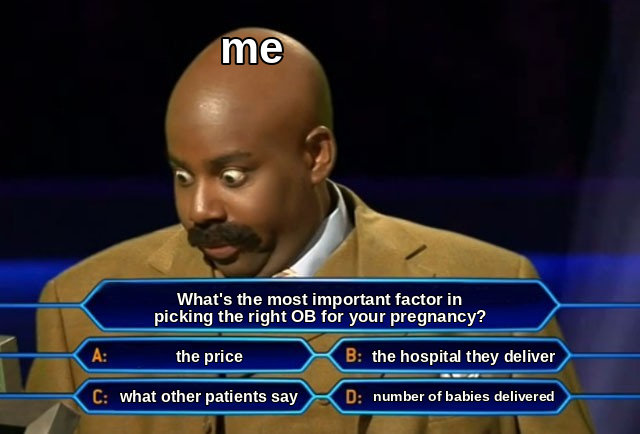
Almost all of the marketing you hear or see from hospitals around pregnancy is around the amenities. This makes sense because those are the things regular people can evaluate. But it’s not entirely clear to me that leads to patients picking the right place to get care for their situation.
New York is a competitive provider landscape and each hospital markets slightly different reasons why you should pick them. Sinai is all about being flexible with your birth plan and has partnerships with companies like Oula for births with midwives. Weill-Cornell is all about the private rooms and the Chanel bag of samples is now notorious. Lenox-Hill will not stop subtly hinting that Beyonce gave birth there and they have VIP suites.
At the end of the day, we mostly just asked our friends who gave birth what their experiences were like. I get the sense that’s what most people do.
Basically you’re trying to predict what kind of pregnancy/birth you might have and kinda hope the OB you chose meets your needs. I’m still pro patient shopping. But this was a good example where it’s...kind of hard to even know how you’re supposed to shop. There are just too many dimensions and it’s hard as a regular person to know what to prioritize.
Also totally unverified so don’t quote me on this. A friend of mine that works at a hospital told me that they really try hard to make the pregnancy/birth process comfortable because:
- They want you to have your second kid there, it’s one healthcare journey you’re likely to do multiple times (and a patient population that tends to have good commercial insurance).
- Moms tend to make healthcare decisions on behalf of the entire family, so having a good impression with them is important.
- They value their lives - hell hath no fury like someone on Pitocin.
Out-Of-Pocket is also supported by...

The birth itself - it changes in a flash
We had a great birth experience at the hospital. For 18 hours it was pretty uneventful, but in the last 10 minutes things became true chaos as the baby's heart rate dropped.
We ended up having to have an emergency C-section. It’s a very surreal moment - one minute the vibes are good and Ozuna is playing in the room, and suddenly a red button is being pushed and literally 14 people run into your room. I haven’t listened to Baila Baila Baila since.
But it was like watching an F1 team - every person knew exactly which cords to unplug, which medicines to put in, and what to prep. From when we knew the C-section was happening to hearing our baby crying was no more than 6 minutes. I have such respect for all the professionals in that situation - they were extremely competent and the right level of empathetic and honest.
Some people will tell you to avoid hospitals that do C-sections because they’ll pressure you into doing one. But in that moment you’re so happy to be at a hospital that does a lot of C-sections because they’re good at it.
It’s also surreal to be the partner. You scrub up to go into the operating room - there’s a curtain to prevent you seeing the surgery but you see your partner in a puddle of their own blood. As an ordinary civilian you have no idea what’s normal or not, your entire read of the situation is basically reading the tension in the room. Everything was very terse until the baby came out and people started having casual conversation - that’s the only way to read if things are normal or not.
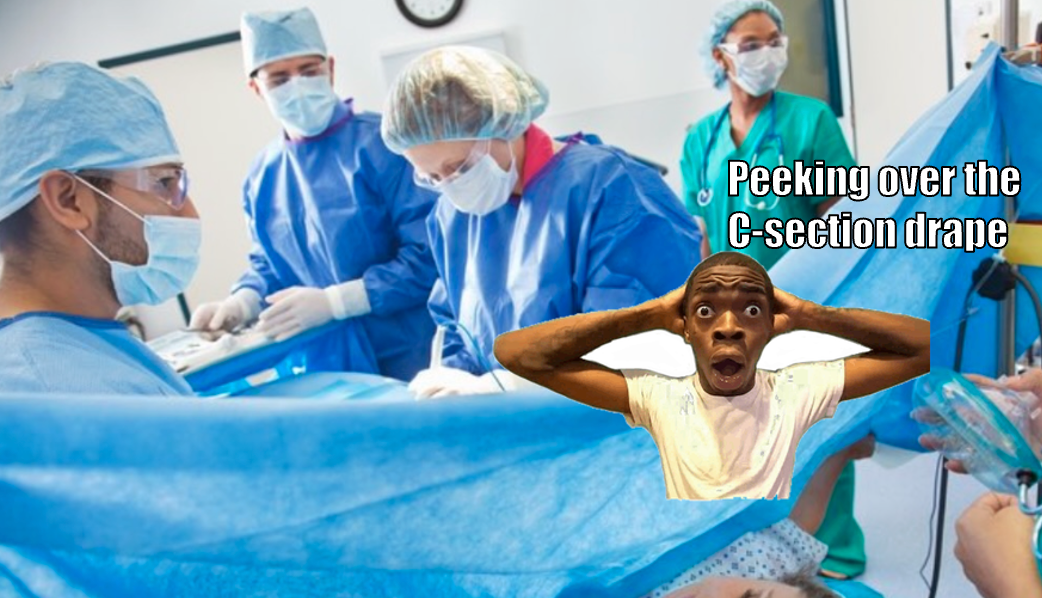
Random assortment of notes from the hospital itself. The big caveat here is that we gave birth at an academic medical center in New York. This is different for many reasons, the biggest being that they have to manage patient volume more than anything else.
- We had so many residents as a part of our care team. They were all very good/professional and it was actually cool to see teaching moments happen live. But it’s funny how many people told us “make sure only attendings can see you”. If we did that we wouldn’t get seen by any doc for hours, it’s just not possible when the floor is full of other patients too. And if that epidural didn’t come right when it did, the anesthesiologist would have been the one knocked out.
- Triage is straight chaos especially if you come during a peak time. Because everyone is running around and it’s frequently different people coming in, it’s one of the clearest places you need to stay on top of things yourself as a patient. But it’s wild to see other parents getting their blood pressure checked in the hallway - I have a lot of respect for labor & delivery ops at hospitals because all of it gives 3 AM Waffle House energy but 24/7.

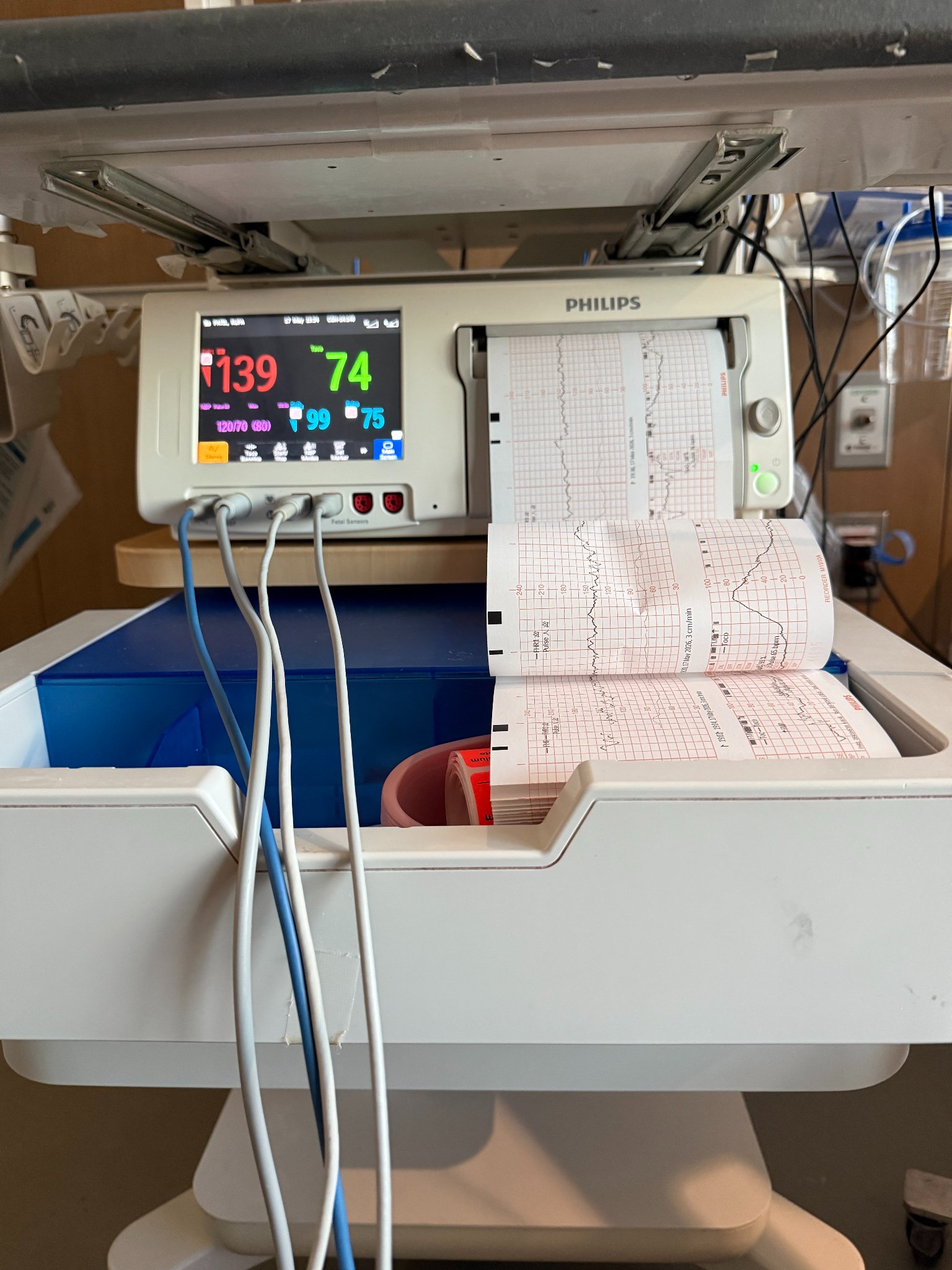
- It is crazy how many sounds come out of the machines, it’s like a symphony of false alarms with the fetal heart monitor as the overconfident but bad soloist. And the number of people that come to check some measurement in the middle of the night...all in all it’s impossible to sleep and my Oura ring was telling me to just kms at that point.
- It’s funny how for us, it’s one of the biggest moments in our lives but for everyone we interacted with during the birth it’s like, just another day in their job. We called the hospital on the way there and I yelled “we’re coming in to deliver!” and the woman on the other line in the most deadpan voice just said “come to the front, congratulations”. I have had phone conversations with more excitement from banks calling to verify me.
- So many of the machines in the hospital capturing measurements still print out these reams of paper the entire time you’re there. It feels wrong that it’s faster to go through the paper to find anomalies vs. asking a computer.
A side note bit about C-sections
It also sent me down the rabbit hole of C-sections in the recovery room as I tried to make sense of what was happening. Men will literally read PubMed instead of going to therapy.
Most important - just like the Caesar salad the Cesarean section has nothing to do with Julius Caesar. I thought it might be because, you know...of the way he went out...but it turns out no one is quite sure where the name came from. We just ride with it cause it sounds sick.
C-sections were basically a death sentence for the mother for a long time, but over the years the techniques to open/close the uterine lining have improved substantially. In the last couple of decades, there’s been a lot of focus on post-operative recovery which involves gently pushing the body slowly instead of staying in bed.
Recovery was still intense for my wife, but less bad than we expected (we may have gotten lucky). I think the new protocols have really improved post-op recovery time compared to our parents' generation, which essentially had you bed bound for a month+, totally incapacitating you.
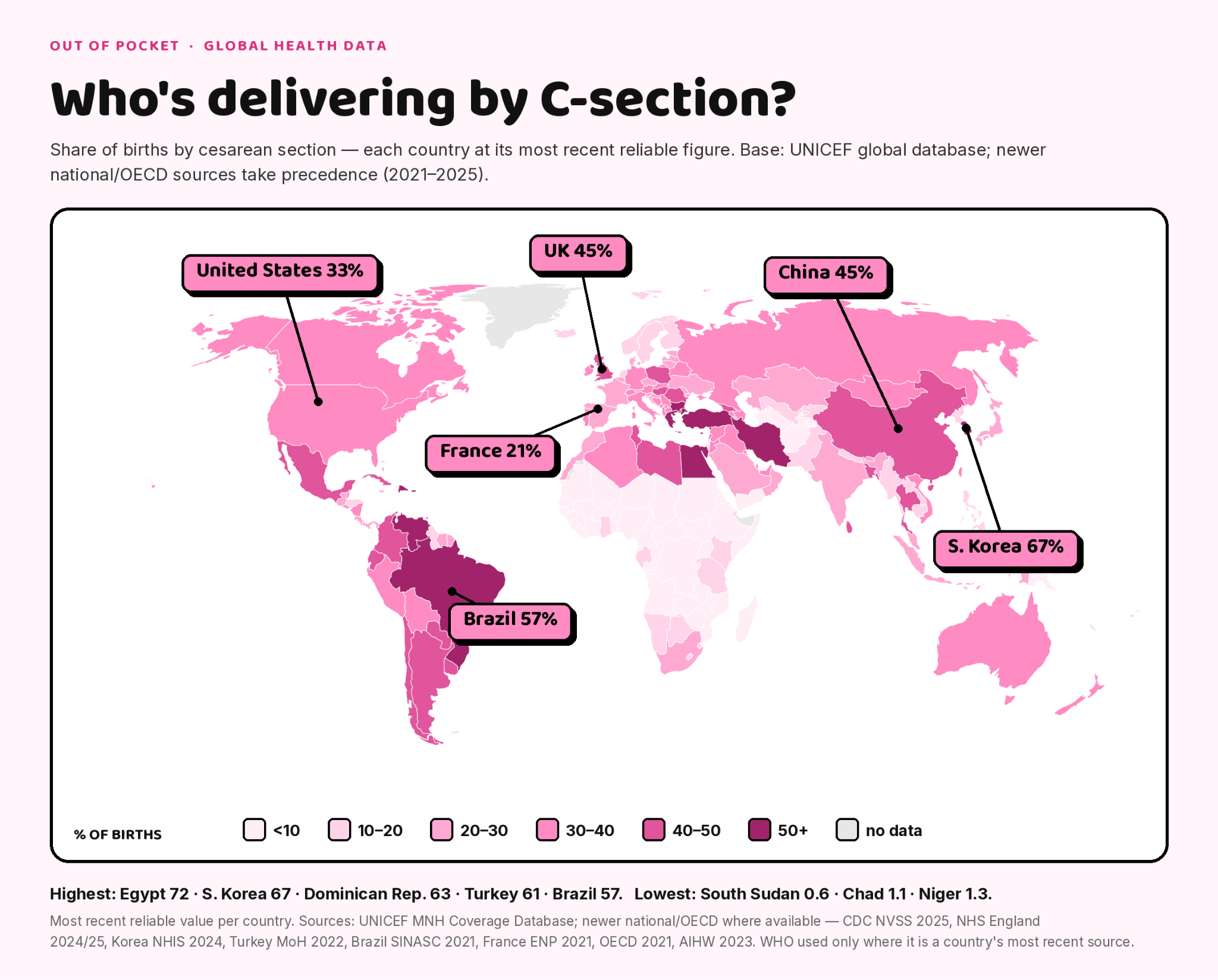
Also I assumed the US was way higher on the C-section rate compared to other countries, but that doesn’t actually seem to be the case. About a third of births in the US are C-sections, but that’s lower than the UK! And some countries like Korea have more than 2/3rd of births as C-sections. I made a map with some of the data I wrangled if you want to see, a lot of this seems to be due to people being older when having babies. Or BTS somehow.
The first two weeks after
I still can’t believe after a couple days the hospital just...gives you the baby and tells you “good luck”. No one teaches you how to bathe the baby?? When should I feed him??
Then you’re home, and you realize your place is a mess and you forgot to take one of the trashbags out and there are so many boxes everywhere. The first two weeks are insanity because the birth partner is physically recovering and you’re trying to figure everything out.
Postpartum recovery is one area the US is particularly lacking compared to other countries. Korea has dedicated postpartum care centers that are basically recovery hotels (maybe that's why they’re all getting C-sections). Netherlands has something called kraamzorg, where a trained maternity nurse comes to your home for like 8 days after birth.
For us it was about comfort, but even from a health outcomes perspective this matters considering >40% of postpartum maternal deaths are within 42 days of the birth.

The hospital doesn’t even give you recs on agencies or places you can find this info, you basically have to search through facebook groups wading through veiled anti-vax questions, spreadsheets from friends, and sus classifieds. This feels like a missed opportunity for the hospital!
I’m also surprised there isn’t a list they give you of “here are things that seem like they’re medical issues but are totally normal”. Like did you know about hemangiomas, these bright red growing bumps that can form on babies skin but are pretty harmless and go away? Or did you know that babies' eyeballs move in different directions and they look like Steve Buscemi? Claude was at least able to help alleviate some of that stress knowing it’s not urgent enough to go to the emergency department.
Why share all this? Conclusion + part 2 soon
A lot of people reading this are probably thinking to themselves “damn...that’s a crazy amount of personal stuff to overshare”. I doooon’t have healthyyyy boundarieeeesss!
But that’s kind of my point - pregnancy and birth is such a solo journey for families. It’s really hard to figure out how your situation compares to others, how they navigate it, etc. because people hold their cards very close to their chest. Maybe if we talked about some of this more openly, the whole thing wouldn’t feel as weird, scary and hard to figure out what’s normal.
And now I have a 50 step plan for a perfect pregnancy that you can get for the low price of...nevermind.
Would love to hear if any of this resonated with you, if you disagreed with it, or if there’s anything you wish others knew, etc. In part 2 we’ll cover all of the data and information you get during pregnancy and part 3 will cover all the bills.
You can sign up for the newsletter to get the next parts.

Thinkboi out,
Nikhil aka. “Thinkdaddy”
Thanks to Jennifer Rohs and Laura Heacock for reading drafts of this
Twitter: @nikillinit
Other posts: outofpocket.health/posts
Quick Interlude - “Am I a fit for Knowledgefest?”
See All Courses →Based on the questions I’m getting about Knowledgefest, I’m doing a really bad job explaining who should come.
The conference is for anyone building in healthcare.
- It is not specific to companies delivering patient care - Lots of people at software only, insurance, etc are coming.
- Any size of company can come - We have two person just out of YC companies, people that run ops at clinics, to F500 companies.
- You can be any role - Almost every role touches ops in some way. Product, founders, clinical, etc. should definitely come.
You should apply if you’re not sure, and we’ll let you know :)
Get Out-Of-Pocket in your email