How to make a good first impression at a healthcare job
Get Out-Of-Pocket in your email
Looking to hire the best talent in healthcare? Check out the OOP Talent Collective - where vetted candidates are looking for their next gig. Learn more here or check it out yourself.
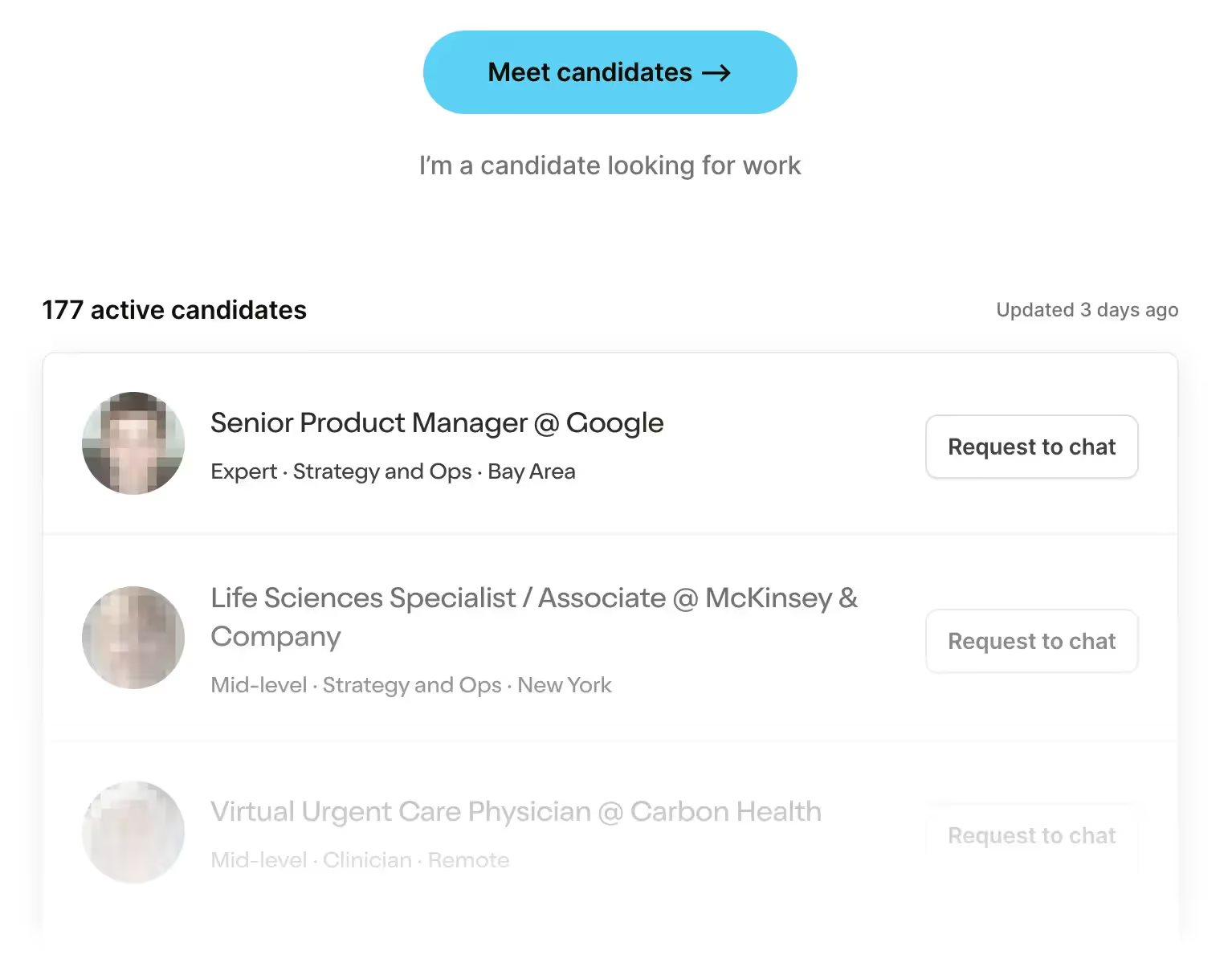 Hire from the Out-Of-Pocket talent collective
AI Agents in Healthcare Ops 101

Featured Jobs
Finance Associate - Spark Advisors
- Spark Advisors helps seniors enroll in Medicare and understand their benefits by monitoring coverage, figuring out the right benefits, and deal with insurance issues. They're hiring a finance associate.
- firsthand is building technology and services to dramatically change the lives of those with serious mental illness who have fallen through the gaps in the safety net. They are hiring a data engineer to build first of its kind infrastructure to empower their peer-led care team.
- J2 Health brings together best in class data and purpose built software to enable healthcare organizations to optimize provider network performance. They're hiring a data scientist.
Looking for a job in health tech? Check out the other awesome healthcare jobs on the job board + give your preferences to get alerted to new postings.
This episode of Out-Of-Pocket is brought to you by...

Elevate, Medallion’s annual virtual event on September 1, brings together healthcare leaders to explore AI’s real impact, shifting regulations, and what it takes to scale without losing the patient experience. Expect candid conversations on the tensions shaping the industry and practical perspectives on where we’re headed.
–
Wanna get in front of people that actually like reading? Let’s chat OOP sponsorship.
Your 90 day plan is here
Last week I asked what you should actually do when you start a new job at a healthcare company. You all came through, with very good answers. It is interesting to think about the tensions between:
- When do you use AI in smart ways during onboarding: e.g. learning new skills, taking a first pass at understanding something, but also not deteriorating your critical thinking.
- Getting quick wins vs. coming in too hot with solutions. You need to scope appropriately and be tactful in how you do it.
- Figuring out the right people in the org to know to get things done while not wasting people’s time + coming off as a corporate ladder climber.
Here were some of my favorite ones people sent in. Notes and memes by me.
Go for a ride along, see patients, touch grass
“The #1 advice I give to people starting in eng/product roles at a healthcare company is to go for ride-alongs/gemba walks. The Toyota manufacturing process defines gemba as ‘the place where value is created’ - traditionally factory floors, service shops. The idea being to bridge the gap between what management thinks is happening versus the actual reality. You should go into a gemba walk with a specific question - with onboarding it should just be as simple as “what is this team, what do they do and what are their pain points.” You’re not just hanging out for the day, you’re an active observer looking to learn and improve on processes. You’re also not responsible for fixes or giving timelines - a tricky balance to maintain

Echoing Nikhil’s point about asking dumb questions, you should use that first 30 day period to actually sit down and see what processes exist in the company. Not reading a document that someone wrote 2 years ago, not just telling claude to analyze the codebase but actually spending a day with the people that are going to use your product. If you work on scheduling and booking pages you’re riding the front desk or T1 support, if you work on tools for providers you’re going to shadow visits. If you work in RCM you’re just gonna have to follow everyone around and regret your life choices. It’s super fun and honestly a great way to bag off staring at code and Jira tickets
An immediate win from this is a) a deeper understanding of the company as a whole, not just the tech and b) social capital. The example I’ll use is fixing a slow query at a previous company. In a purely product world it wasn’t even the worst query in NewRelic. However it was on the ‘hot path’ of patients checking in - at the front desk a button would spin for 5 seconds which is a lifetime when someone is just standing there. ID’ing that query and fixing it did wonders for morale and gave a feeling that technology is there to actually help people, instead of just being something you have to fight”
— From Gus Ireland
[NK note: I’m actually upset at myself for not saying this one. GO INTO THE FIELD!!! I can’t believe how many people don’t do this. The main benefit of being in health tech is actually seeing your work is directly impacting people.
Plus you’ll learn how much gets lost in translation when someone like a frontline staff is explaining their problem to you vs. just seeing it first hand.
To this day I’m still trying to let companies ride around with them. If you’ll let me shadow your team for a day in the field, I’d love to do it.]
Knowledgefest Applications Due!! Happy hour in NY!
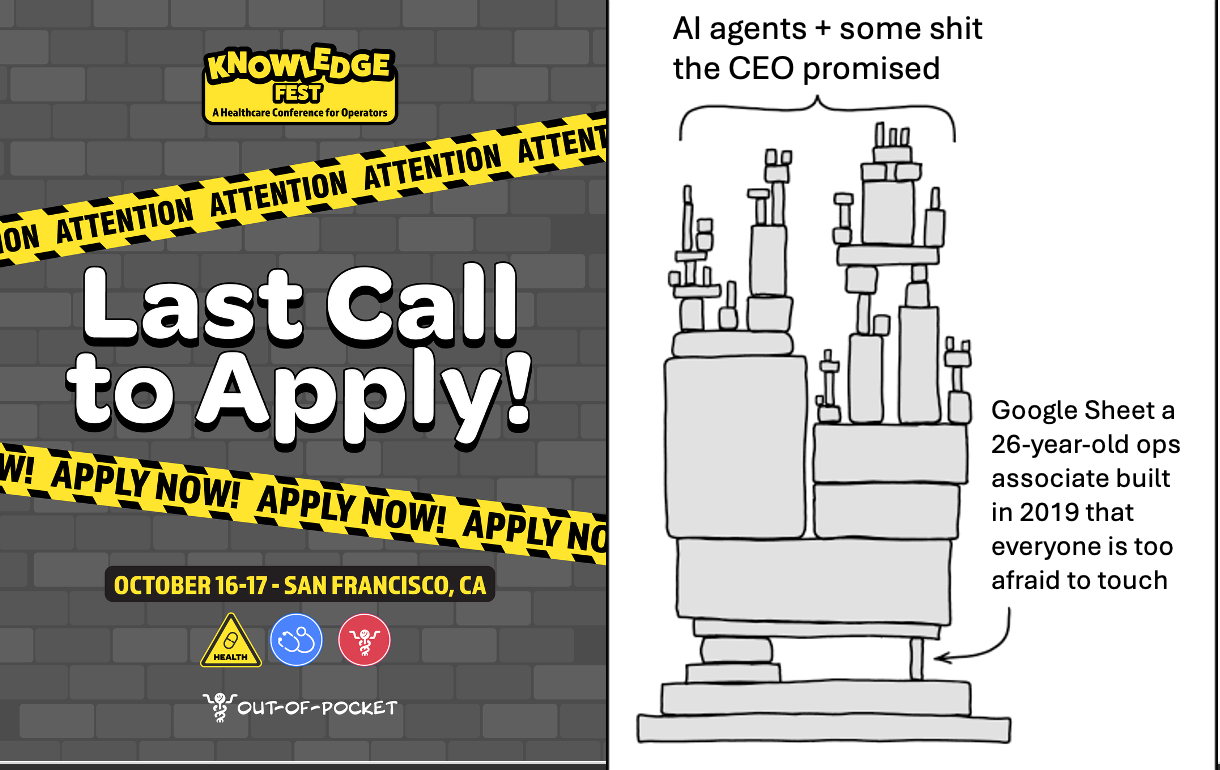
Oh you like onboarding? Why don’t you come PROVE IT...at Knowledgefest, our conference for healthcare operations.
We’re getting 100 of the best ops people in a room to hash out how to actually build healthcare companies and get the ACTUAL answers to questions.
If you’re knee deep in ops at your company and you’re good, you should apply today.

And for people in New York, we’re doing another happy hour with our friends at Bunkerhill Health on 7/30. We’re bringing together people that have done implementations and “forward deployed engineering” aka. consulting but slightly more tech-y.
We have limited space, but if you’ve done on-site implementations you should come.

Draft your own 6-month review and do it
“A few I’d throw in:
1) Find a place you can add value and do it immediately. It will create a meaningful positive reputation and open doors.
2) Healthcare is a rare industry where a lot of rules are written down. Read the primary sources.
3) Biz school tip my wife got ... 2 weeks in, take a few hours and try and write down what a successful first 6 months / 1 year would be in this role. Maybe draft it as a performance review you’d receive. Hand it to your boss. Have them sign off. It’ll help you know where to focus, and what good is. Then you can go do it.”
— From David Freed
[NK note: In 6 months I think I’d be successful if I fucked up some commas. Please sign off. ]
Find the white space and plant your flag
“1. Find an area of “white space” and own it. Companies are always fighting with too many priorities; as a new person you have a few weeks before you start getting assigned real work, and your manager is also figuring out what they can slot you into. This is a great time to find problems that are being neglected, ask a bunch of dumb questions, and start proposing solutions to them - it could give you a first low hanging fruit to go solve.
2. Figure out who the decision makers are. You’ll often observe things like “I’m doing X but waiting for Y’s input”, “this is Y’s decision”, etc. There are usually very few decision makers with influence at the organization and it’s important to know who they are and how to present ideas to them.
3. Learn the business model. Understand where the money is coming from (harder than it may seem in healthcare!), what drives the business to work, and what the company’s role in the market is. Culture and priorities will likely stem from these things - and they’re important to tie your work back to.

In healthcare 101 we walk through a lot of these money flows to help people understand these somewhat complex flows
4. Lay the path towards finding mentors. If you have more senior / skip level meet and greets during your onboarding, try to be earnest and curious. New meet and greets honestly present a chance for them to take a moment and step back from the day to day, reflect a bit on their own journey through the company, and open the door for mentorship. These tend to be especially valuable as you learn to navigate the company.”
— From Eshan Tewari
[NK note: You know, I never really found a mentor at my jobs and I kinda regret that. I think building rapport with someone who would push you/stick their own neck out for you can be a huge career accelerant. And they’ll say things like “Don’t rely on your power. Rely on your heart.” before being killed by the antagonist and then you have to avenge them.
A good way to become someone’s mentee is to find that white space and help out the person who owns it.]
Write it down yourself and no AI slop
- Understand the business model of your main customers or stakeholders quickly, no matter whether your role is customer facing or not. You’ll understand what keeps them up at night (often / hopefully not your product!) and will better understand how to serve them well. At the very least, in 6 months you’ll know so much more about the healthcare ecosystem business models!
- Once you think you understand something well, write a very short “knowledge base” or wiki-style blurb around it. But please, for the love of God, no AI slop. Write it yourself. Share it with your team members to make sure you understood the thing well. You’ll learn that something so much better by virtue of writing it down, and will now have a piece of collateral that could help others, too.

- After you understand them well, automate the boring or repetitive tasks of your role to the extreme.
- Bonus for those working remote: meet someone new (local colleague, customer partner) in person at least once a week for the first quarter.”
— From Vera Mucaj
[NK note: Big yes to understanding the business models of your customers. You will answer a very important question, which is “is my business a sidequest for these people or an actual ROI driver”.
Importantly you will also figure out if your customers value your skillset or not. If you’re a designer and you’re joining a company that does not care about how good the product looks, it’s a good opportunity to build skills in areas that they do care about (e.g. whiteglove onboarding).
Or hobbies outside of work. That sounds like a joke but I’m being serious, get a hydroponic herb garden and just be self-aware of your situation.]
Don’t walk in assuming everything’s broken
“Med Device/Biotech Marketing and Strategy Recruiter here:
- Maintain status quo as you learn, adopt the systems in place fully as you onboard. Don’t come in assuming things are broken or inefficient and you have a better way. Sometimes things are subpar, sometimes there’s a good reason projects or processes are done a certain way. Get some experience under your belt before you suggest changes.
- Don’t constantly talk about how your last company did things. There’s a “This one time at band camp” joke in here in the spirit of OOP’s humor. You’ll have good ideas to introduce, just don’t be a broken record talking about your last company repeatedly.
- Start a file right away to document your wins and accomplishments. Much easier to collect them along they way than go back retroactively.”
— From Anonymous

[NK note: I’ve seen several people come in HOT at companies trying to suggest revamps to systems - it almost always leaves a terrible first impression.
Honestly the suggestions might not even be wrong, but sometimes delivery and process are important. Take some time to listen and chat with people, understand why things were chosen to be done a certain way, and give a few small suggestions before the full overhaul.]
Get AI-pilled before “this is how we do it” sets in
“Like it or not, AI is here to stay. I’ve seen many people who played around with AI tools early on and decided “they’re not very good at complex things.” But AI models are getting quite impressive and approaches to work are changing rapidly, so I think it’s important to keep up.
Starting a new job is a perfect time to explore how AI can help you, before “this is just the way things are done” sets in. If your company is trying to figure out how to use AI more, your fresh perspective can be more valuable than you may realize. And if your company doesn’t allow AI tools yet, you can still gain a ton of experience by using AI for tasks outside of work. So go at it, try asking Claude Fable (included in $20/month Anthropic plans until July 19) or GPT-5.6 to work out talking points, create a slide deck, and set up a dashboard to help visualize your work.
Establishing yourself early on as someone who stays up to date with what AI can and can’t currently do can help make you valuable at your new job!”
— From Jenine John
[NK Note: Like Vera said above, be self-aware when you’re outsourcing your critical thinking skills to LLMs. Or whatever just be a ChatGPT wrapper, your company probably is anyway.
But practicing using AI tools to augment your core ideas (e.g. creating visuals, or creating agents to execute functions) is a great idea. This is a core pillar of our events - creating spaces where people can play with these tools outside of work with some handholding. For example, at Data Camp we had a cursed chart competition to make intentionally bad data viz but it’s also a great way to learn prototyping capabilities.]

Do the groundwork to figure out the org
When starting at a new role:
- If your organization uses AI, use it as your onboarding buddy first. It’s a great resource for company knowledge, and it allows you to ask opening questions that have a little bit more context behind them. When someone comes to me and says “it seems like we’ve historically done [thing] when [situation] but I’m wondering if you can help talk me through [details of thing]”, not only am I much more likely to answer quickly, but I’m also more likely to be able to come prepared with the answer you need vs. a question of “what happens in [situation]?”? This advice holds true even in an AI-less world, but I think its much more accessible and low effort to take a first pass now.
- Set up intro meetings with as many people as you can, and have a set interview script so that you can make the most of the time. People love helping new people onboard, but people hate an aimless 30 minute 1:1. Especially if you are joining an org where the average tenure is >2 years, people you meet won’t remember what it’s like to be new and won’t be in touch with what’s worth sharing with a new person. Create your own script but a few Qs I’ve always found helpful
- Ask about them in general - where they live, kids, etc
- What were the biggest things you/your department worked on last year and how did they go?
- What are some areas you think might be challenging for my role/department, and how can I help?
- What are you working on now, and how is it going? What blockers do you have?
- Who else do you think I should be chatting with?
- [use wisely based on context] What’s your favorite piece of organizational lore you think I should know? (e.g. “don’t talk to Bob without bringing a full page document”, “Remember the time the C-suite did a YMCA dance for the all hands?”)
- As you onboard, you’ll find things that were harder than they should have been to do: access that was more annoying to get, a process that had drifted from its original state. When these happen - document them! This is perhaps the single biggest impact you can have in your first few weeks anywhere. You won’t be making large strategy decisions but you CAN make it clearer and easier for the org to run
- Related to the above - listen and ask more than you assert and decide for the first month or so. Ask teams about their processes, read documentation, play with the product you own, if you can - talk to customers or listen to people talking to customers (yes - even if you are in an extremely technical or non-client facing role!), learn what the business reports on and how you’re doing this quarter vs. last quarter, this year vs. last year. You will never have this much time again to absorb all the little details - do it now, you will always have time to produce net new content/ideas later, you will never have this much time to listen again
— From Erin Nicolle
[NK note: One funny thing you’ll find as you do this is that different people will have different answers to these questions. X person will say a project failed because of Y team, while Y team will say it’s cause of the customer. If you’re new, this will of course be extremely confusing and your job will be to try and assess ground truth. Remember that most people will not want to take blame for things that are going wrong.
As an aside...as a new parent I can’t believe I never really asked other parents about their kids. Like it’s by far the most important thing in their lives, and I’m just immediately jumping into questions about dashboards lol].
Pretty good tips! You’d be a FOOL to not take them.
Thinkboi out,
Nikhil aka. “30-60-90, damn you fine-ty” aka. “Yes, the company you’re joining also is a shitshow internally surprise”
Quick Interlude - “Am I a fit for Knowledgefest?”
See All Courses →Based on the questions I’m getting about Knowledgefest, I’m doing a really bad job explaining who should come.
The conference is for anyone building in healthcare.
- It is not specific to companies delivering patient care - Lots of people at software only, insurance, etc are coming.
- Any size of company can come - We have two person just out of YC companies, people that run ops at clinics, to F500 companies.
- You can be any role - Almost every role touches ops in some way. Product, founders, clinical, etc. should definitely come.
You should apply if you’re not sure, and we’ll let you know :)
Get Out-Of-Pocket in your email