Real talk if you’re looking for a job at a health tech startup
Get Out-Of-Pocket in your email
Looking to hire the best talent in healthcare? Check out the OOP Talent Collective - where vetted candidates are looking for their next gig. Learn more here or check it out yourself.
 Hire from the Out-Of-Pocket talent collective
Healthcare 101 Crash Course
%2520(1).gif)
Featured Jobs
Finance Associate - Spark Advisors
- Spark Advisors helps seniors enroll in Medicare and understand their benefits by monitoring coverage, figuring out the right benefits, and deal with insurance issues. They're hiring a finance associate.
- firsthand is building technology and services to dramatically change the lives of those with serious mental illness who have fallen through the gaps in the safety net. They are hiring a data engineer to build first of its kind infrastructure to empower their peer-led care team.
- J2 Health brings together best in class data and purpose built software to enable healthcare organizations to optimize provider network performance. They're hiring a data scientist.
Looking for a job in health tech? Check out the other awesome healthcare jobs on the job board + give your preferences to get alerted to new postings.
Just a lil’ advice from an young old head
Most times here I talk about healthcare stuff. But every so often I’ll dispense some wisdom that only a 33 year old who hasn’t interviewed for a job in 7 years could.
I’ve been having a lot of conversations with people looking to work at a healthcare startup. Unfortunately it’s clear that no one has had the hard conversation with them about their prospects or approach. So I’ve decided to be your parasocial relationship that’s sitting you down and having a real talk convo with you.
This isn’t REALLY healthcare specific, but whatever I have other interests too you know. Many of these notes are from people that WISH they could tell applicants these things, but for obvious reasons can’t be honest with them
This advice is more specific for people looking for jobs at startups, I don’t understand F500 companies or your weird leveling mechanics like L7 Engineer Mage and their very strict interview protocols.
**I’m going to put the very obvious disclaimer that all of this applies if you have a safety net, you’re not in financial dire straits. This is for people that have a bit of wiggle room in their job search.
Do you want a job that makes you look cool to friends, or makes money?
IMO you should be honest with yourself about which of these you care about more. You are likely sacrificing one in pursuit of the other.
For example, people end up optimizing for titles that look good on LinkedIn. Or look for titles that don’t exist because they sound good (e.g. “strategy” is not a role at a startup, sorry). Companies also know to make roles sound nicer, knowing that people will be more attracted to it even if the role duties and comp are the exact same.
Or another big one in healthcare is choosing a company because of the “mission”, which is something that’s easy to tell friends and get the feel good reaction. I already wrote about how saying mission is way too vague. But more specifically, companies with feel good missions either get way more applicants as a result OR have a way harder time making money, both of which means lower comp.
I also know there are a lot of people that would do REALLY well in sales but think it’s beneath them from a social status perspective. Let me tell you…good sales people are absolutely raking it in. And startups are almost always looking for good sales people because they’re rare. IMO many product managers I know should be doing this instead…just saying.
You can tell me whatever you want about your job search and “wanting to work somewhere you’ll have an impact”. Just be honest with yourself about your priorities and know the cooler sounding jobs will be harder to get.
You should be opinionated
A lot of people hold back opinions that they have in the interview because they think it’ll hurt their interviewing prospects. Or worse, actually don’t have strong opinions on the best ways to work or how things should be done.
The reality is not having any strong opinions will probably end up hurting you in two ways:
- You basically will look exactly like all of the other people interviewing and it’ll be hard to remember you/differentiate
- You might have an opinion that is truly at odds with how the company operates, and even if you get the job you’ll be miserable because of that difference. The interview lets you suss that out.
Have opinions, they will help you more than they hurt you and will probably lead to good discussions. Some ideas on specific things to have an opinion about:
- Where do you think the company should expand or even what features/products do you think they should kill?
- How would you have implemented X differently (process, tool, staffing model, etc.)?
- What is a specific cultural value you think is important for startups to have even if a lot of people at the company will disagree with it?
- Your opinion on what tradeoffs should be made in X scenario.

Are you actually good at your job?
I’m not sure a lot of people know where they rank on the distribution curve when it comes to how good they are at their job. Are you “cracked”, “chopped”, or somewhere in between?
For example, I see a lot of people that have progressed up the ladder at large companies who believe that progression means they’re good at their job. But then they go to a startup and realize that the skills needed are completely different. Another common one is people who get degrees from X institution and assume that means they have the skills to crush at a job.
This matters for a few reasons:
- You might be choosing a level that you are not actually ready for, and you’re going to be set up for failure.
- Each startup will look very different by stage and you should hone in to the stage that suits you. You might be someone who really needs a task list and sucks in unstructured environments, then you should go to a later stage company.
- Because of the flood of applications and people resume buffing (almost to the point of lying), backchannel references have moved to the front of the process for many companies. Will someone say you’re good if they’re called?
- You can be 50th percentile or below and get a job, but then it also means you need to change your approach to jobs or how you want to bolster your skillset. Find a separate intersecting skillset that makes you much rarer. You might be a 50% ops person, but if you can show some mastery with AI tools, content, or sales you suddenly jump to a different tier or role that can combine those.
Not everyone is the best at their job, that’s fine! You just need to re-adjust your approach to finding jobs or skill building accordingly.
Unfortunately very few people will give you that honest assessment. You need to create an intentional space where someone is allowed to rank you and give feedback - mentors are great for this, or just ask me and I’ll f*** you up. Or you need to do a more critical assessment of yourself, AI tools can actually be helpful here if you give them the right prompts.
{{interlude 3}}
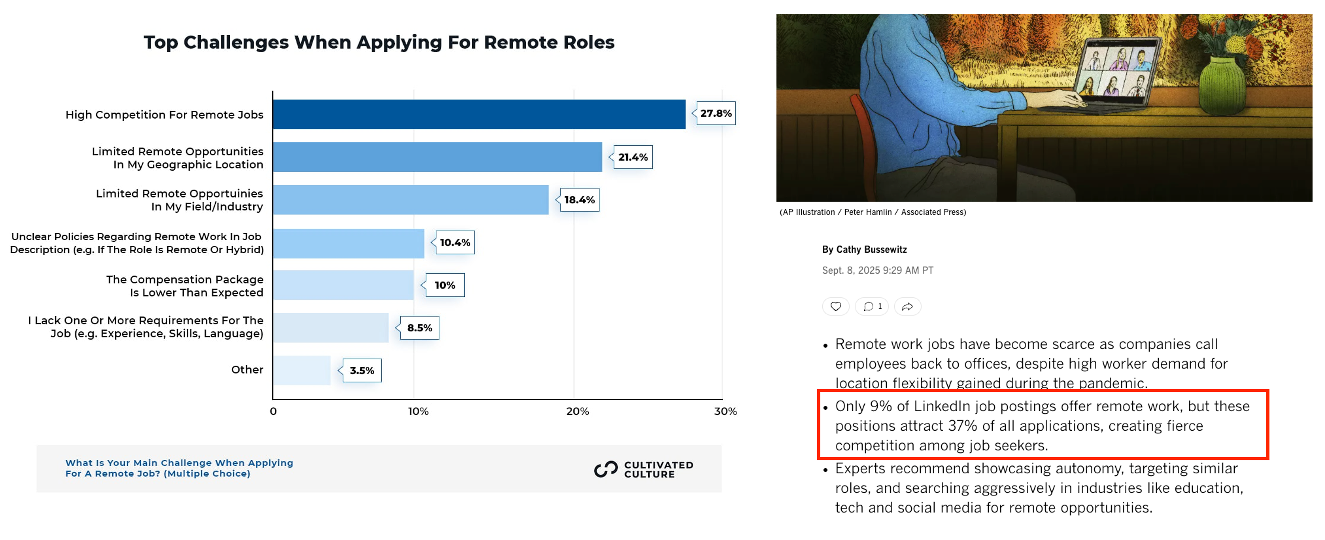
Remote roles will have 10x the competition
Remote roles sound great from a lifestyle perspective, but just know that every remote role has 10x more applicants than hybrid or in-person roles. This will also yield lower compensation because of that competition.
These remote roles are also more at risk of being outsourced to an offshore agency. For people that are under the impression that offshore talent is lower quality or can’t do certain things, I am telling you that is cope. Offshore talent has gotten phenomenally better - and the really good ones have been using AI tools to give themselves superpowers.
I understand why people are looking for remote roles, but I also think some people are under the impression that the landscape is similar to COVID.
Clinician reality check
Most of my clinician homies have never gone through a real job interview. Actually their first real job was at like 35, and now they’re on White Coat Investor asking how 401(k)s work.
I am getting a lot of inbound from doctors interested in tech, so I want to just head-on answer some questions:
- There are VERY few options to “dedicate a few hours a month” to a startup. No one wants to hire that unless you are a brand name doc to put on the deck.
- You are competing against a lot of doctors that now have some startup experience. If you don’t have that it’s a much harder sell since the number of positions are much smaller.
- Please understand some of the basic business models in healthcare before you go into an interview.
- Grass is always greener, working at a startup has its own set of problems.
- Compensation models are extremely different from what you’re used to and you will have to NEGOTIATE along the axes of your role, duties, cash, and equity.
I wrote thoughts about whether startups should hire doctors, when, and what doctors should be thinking about when assessing startups.
Write an actually good cold email
It’s clear many of you do not know how to write a good cold email. You don’t know how to slide?????
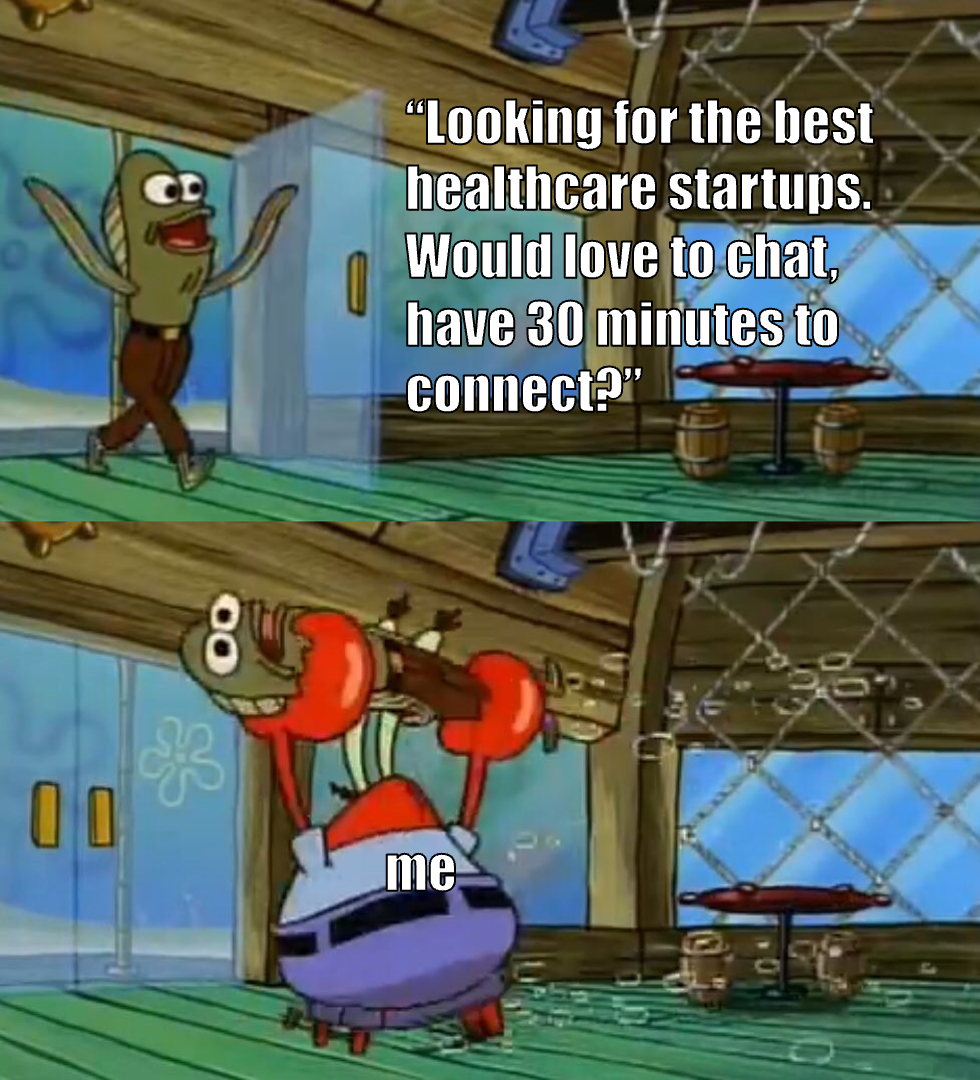
Most people at startups, including CEOs, are consistently responding to emails if they’re good. Honestly, it’s pretty much the entire job. But you have about 15 seconds of that person reading the email before they either delete/archive it or forward it to someone relevant. It’s really not rocket science to write a good cold email:
- Write something very specific about the company or person you’re emailing with your take, reaction, follow up thought. It can even be something you disagree with - sometimes that works better.
- Bonus points - fire up a prototype of something related to #1 on Claude Code, Replit, etc.
- Ask a specific thing you’re looking for help with instead of a vague “let’s chat ask” and give them an out to answer it via email if that’s easier.
- Follow up, people underrate persistence! I have shot my shot 5 times in the same thread.
- Use AI tools to do research on the company, but not to write the email. Everyone can tell when it’s written by AI.
You should also still do this for companies or people you think are interesting even if they don’t currently have a role open for you. The whole point is to be top of mind for when they do start hiring for that role.
A bunch of job postings online aren’t real
I know, this one sucks to hear. An uncomfortably large number of job openings are made already knowing who they’re going to hire! They just need to post it for compliance reasons. So get there before the post exists in the first place.
On top of that many postings don’t have to get taken down, and are left up to keep a pipeline of candidates for future roles if the company grows. I don’t like this, but again I think people applying should at least know this.
Featured jobs
Lucky for you, here are three companies we know for a fact aren’t using fake job postings
Morgan Health – Health Care Analytics Engineer
(New York City, NY, Boston, MA, or Washington, D.C.)
- Looking for a new challenge for your healthcare data warehouse design, dbt, and product design skills? Join Morgan Health's collaborative data team to build scalable, user-centric warehouse solutions that advance our mission to improve quality, affordability, and equity in employer insurance.
MediCircle - Director of Medication Donation Growth
(New York, New York or Sugar Land / Houston Metro Area)
- MediCircle lowers drug costs for patients and health plans by reclaiming unused medications. This hire will lead the growth of our medication donation program by establishing strategic partnerships and activating donor communities to expand the depth and breadth of medications sourced for patients.
Liza Health - Strategy & Ops
(Cambridge, MA)
- Founded by the Founder of Iora Health, Liza is hiring for an early career generalist to join as one of the first 10 employees in Cambridge. Individuals with 2-5 years experience in high growth and/or high agency environments who are analytically-oriented and operationally-rigorous are ideal.
You should be playing with AI tools
The table stakes expectation if you’re joining a startup is that you’re using AI tools to make you more productive. Your examples need to be beyond just inputting things into chatGPT and copying and pasting the output somewhere.
If you haven’t already, I VERY highly recommend giving Claude Code, NotebookLM, Zapier AI or n8n, Replit, etc. You do NOT need to be technical to use most of these, and you’ll be surprised at how much you can do. Take a specific small scale project and test it from there - for example start with making a very basic task tracker for yourself. You can even ask the LLMs how to start doing this and they’ll guide you.

This will also demonstrate that you have agency, a core skill that everyone is looking for but is hard to suss out. They want to see that you have the motivation to start things yourself, create things without people telling you, and you can see a project to completion. If you are about to ask me for a guide on how to use these tools, you’ve already failed the test.
Most jobs at startups are going to ask some form of how you’re using AI in your life or work today, and the more interesting the answer the better. Saying things like “I use it for travel itineraries and recipes” or “I have it help me write emails” just isn’t going to cut it anymore.
[Btw we will actually sit down and teach you some of the AI tools at our upcoming hackathon in SF, 4/17 - 4/19. Whether you’re an expert in them or not, there will be cool tools for you to use AND hardware! Applications are due 2/9]

Ask company specific questions during the interview
At the end of an interview, you get some time to ask questions. Most people ask generic questions that could apply to any company. “What are the company's plans for the future?” or “What’s your favorite part of working here?” or “How did I get here? Wait who are you???”.
These are fine questions, but you should also be asking more pointed and company specific questions at this point.
You saw an announcement, what’s been the hardest part of the rollout? You heard the CEO talk somewhere about X culture aspect, how does that manifest at work? The duties of this role say X today, but if you are successful in 2 years what do you think the role could become?
Whatever it is - this should show you care enough about the company that you did some research and have questions about what’s unique to this company. It starts a conversation and it’s one of the areas you can actually go off script.
Oh and…please understand how the company you’re interviewing at makes money and what their ROI pitch to customers is. If you cannot figure that out after asking questions, that should be a red flag to YOU.
Growth is the cure to all ailments
If you really have the luxury of choice between companies and are debating, always pick the company that seems like it’s growing uncomfortably fast.
Experiencing growth is a fantastic way to level up as a person. New opportunities keep popping up and they’re constantly looking for people internally to step up. It also means you’re not fighting for credit over things because the pie is constantly growing.
This is an area I have changed my mind on recently. I posted online that people should pick teams above all else. But some public and private conversations later have made me realize that growth is actually more important and I’m a silly boy. Healthcare has no shortage of companies with excellent people that have not figured out distribution, and it becomes a fight for scraps. The good people leave for high growth companies.
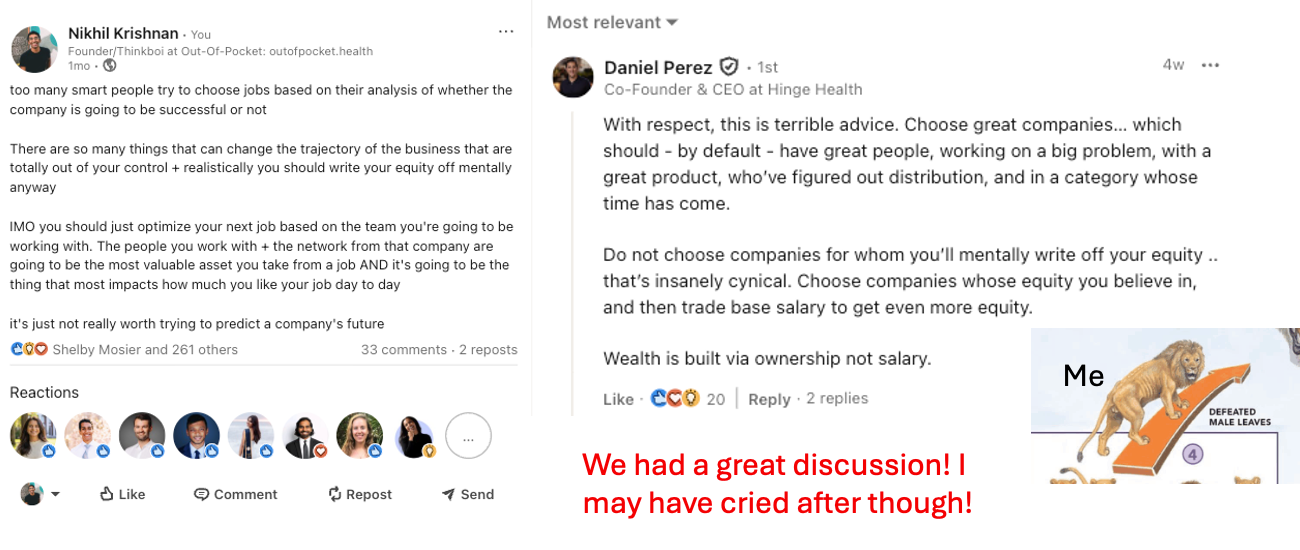
This is triple true of people early on in their career. I had the fortune of joining a company out of college while it started scaling and it changed the trajectory of my life. I thought it’s because I met awesome people along the way, but it’s because awesome people found their way to the company since it was succeeding.
Conclusion - the rules have changed
A lot of startups are hiring, but it’s clear that the way hiring worked in the past is not working.
First, roles themselves are starting to get amorphous and fluid. This is also making it harder to figure out what the right type of person would be a good fit for the role itself. Everyone wants a combo of “get shit done”, “knows and thinks about AI + has an opinion about what it's future looks like”, “knows healthcare at a macro level” that seems extremely rare and hard to assess. The inclusion/exclusion criteria for these jobs are worse than actual trials at this point.
Second is that the level of padding on resumes has become so enormous that companies default assume they’re not real unless proven otherwise. You will be tested on these projects and backchanneled.
And finally, leverage has swung way more to the employer now. They can be pickier and more specific about a hiring process that works for them.
This post is not meant to justify or talk about what’s right or wrong in this process. But I want to highlight to people that the rules of the game have changed because often no one will tell you that upfront. Good luck out there, and I hope this wasn’t too mean.
Thinkboi out,
Nikhil aka. “Just get a job? Why don't I strap on my job helmet and squeeze down into a job cannon and fire off into job land, where jobs grow on jobbies?”
Twitter: @nikillinit
IG: @outofpockethealth
Other posts: outofpocket.health/posts
{{sub-form}}
If you’re enjoying the newsletter, do me a solid and shoot this over to a friend or healthcare slack channel and tell them to sign up. The line between unemployment and founder of a startup is traction and whether your parents believe you have a job.
Quick Interlude - “Am I a fit for Knowledgefest?”
See All Courses →Based on the questions I’m getting about Knowledgefest, I’m doing a really bad job explaining who should come.
The conference is for anyone building in healthcare.
- It is not specific to companies delivering patient care - Lots of people at software only, insurance, etc are coming.
- Any size of company can come - We have two person just out of YC companies, people that run ops at clinics, to F500 companies.
- You can be any role - Almost every role touches ops in some way. Product, founders, clinical, etc. should definitely come.
You should apply if you’re not sure, and we’ll let you know :)
Get Out-Of-Pocket in your email