


Search the Out-Of-Pocket Archives:
FHIR 101


.avif)
.avif)
.avif)
.avif)
.avif)
Things You'll Get From This Course
Get clear on what FHIR is (and isn't)
Learn to read the spec
Understand how FHIR works in the real world
Get hands-on with FHIR

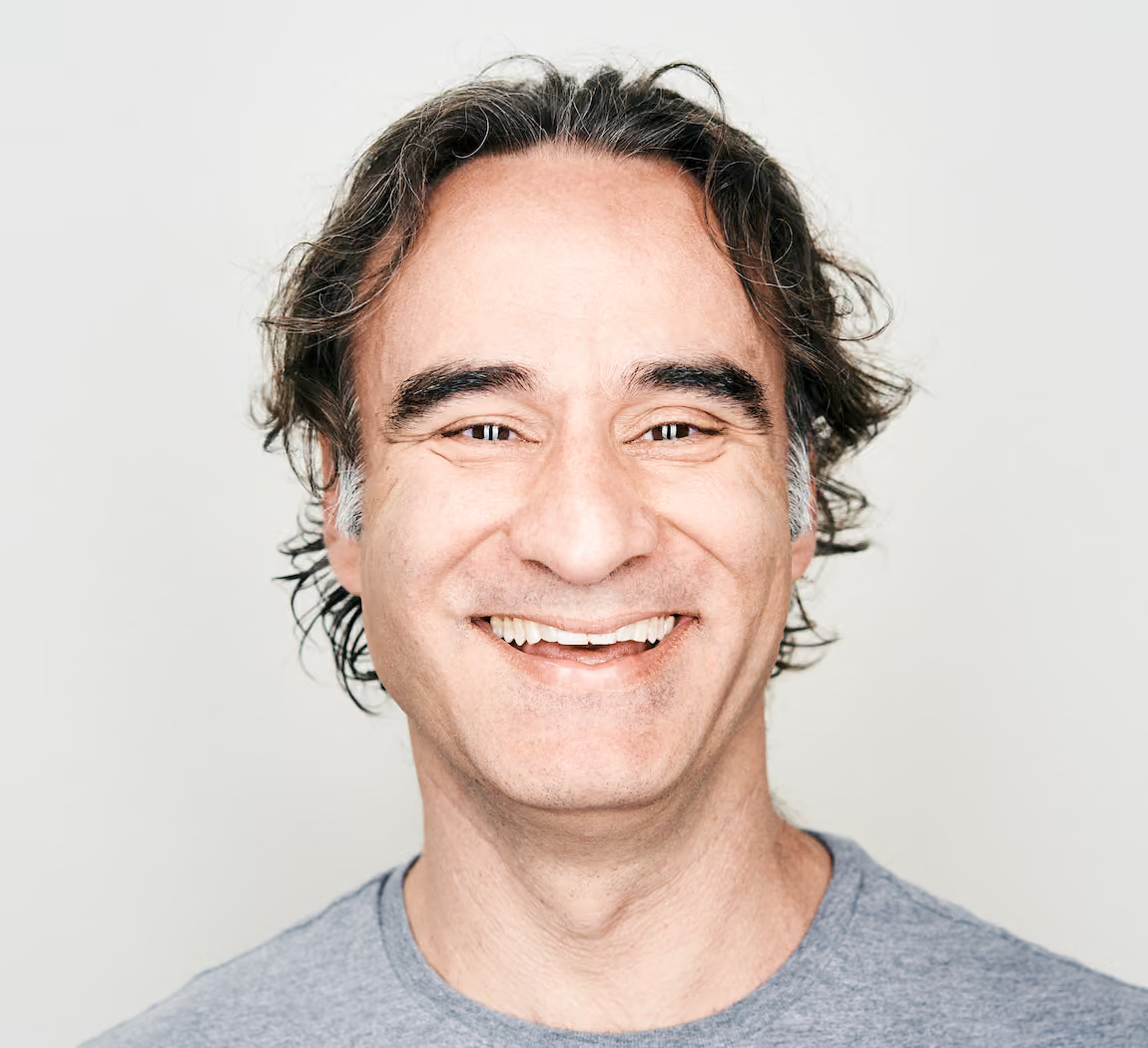
Tim Polsinelli
Tim Polsinelli is a Senior Director of Forward and Solution Engineering at Redox, where he leads the Forward Engineering organization and drives the technical strategy that helps partners integrate seamlessly with the healthcare ecosystem. Before his current role, Tim spent nearly two years as Senior Director of Health Informatics at Manifest MedEx, where he directed the technical and operational roadmap for the organization's designation as a QHIO under AB 133. He previously spent close to six years at Redox in a combination of roles, most recently as a Product Manager for the last 1.5 years and prior to that running the technical delivery team. Earlier in his career he held technical and leadership roles at Epic, including Clinical Integration Product Manager and Integration Engineer, as well as Senior Director of Informatics at The Health Collaborative. Tim holds a BSE in Chemical Engineering from the University of Michigan and is based in Carrollton, Virginia.

Matt Moore
Matt Moore is a Principal API Engineer at Redox, where he has spent over 9 years across roles including Senior Staff Engineer, Engineering Manager, Software Engineer, and Integration Engineer. Before Redox, Matt spent nearly 14 years at Epic, working in Technical Services helping build the largest secure, peer-to-peer healthcare information exchange network in the world, and earlier serving in Quality Assurance as a technical core application tester and primary interoperability application tester. Matt holds a B.S. in General Engineering from the University of Illinois Urbana-Champaign and is based in Madison, Wisconsin.

Gita Vikram
Gita Vikram is an Integration Manager at Redox, where she works on a broad portfolio of healthcare technology accounts, building HL7 and FHIR-based integrations across EHR systems.
Before Redox, Gita spent 8 years at Oracle Health (Cerner), starting out with implementing and supporting consumer-facing population health solutions before moving on to the FHIR integrations team, where she spent 5 years. Gita holds a B.E. in Biomedical Engineering from Stony Brook University and is based in Brooklyn, NY.

Nick Hatt
Nick Hatt is a Principal Engineer at Redox, where he has spent nearly 12 years building the company's core interoperability engineering. Before Redox, Nick was an Interface Analyst at Epic, where he worked on HL7 interfaces, and briefly worked as a Programmer/Analyst at Penn State University. Earlier, he spent two years in Shanxi, China as a Shansi Fellow teaching English at Shanxi Agricultural University. Nick holds a B.A. in Computer Science and East Asian Studies from Oberlin College, with additional study of Chinese at Tsinghua University.
.avif)
Kathryn Schwarz
Kathryn Schwarz is a Senior Technical Onboarding Manager at Redox, where she has spent over 3 years working closely with new Redox customers to help them learn to work with integration standards such as FHIR. Prior to Redox, she worked as an Integration Engineer at both Epic and MediSked, building the technical foundation she now teaches to others. Kathryn holds a degree in Biomedical Engineering from the University of Wisconsin-Madison.

Ben Crane
Ben Crane is a Senior Manager of API Engineering at Redox. In his 6+ years with Redox, he has acquired deep, hands-on experience across healthcare data standards, including HL7v2, X12, FHIR, and CDS Hooks. Prior to Redox, Ben spent four years at Epic as a Technical Services Engineer. Ben holds a BS in Biomedical Engineering from Northwestern University and is based in Madison, Wisconsin.
Course Syllabus & Schedule
Module 1
Day 1

FHIR From the Top
(8/25, 12-1:30PM EST)
Module 2
Day 2
FHIR By the Book
(8/26, 12-1:30PM EST)
Module 3
Day 3
FHIR in the Real World
(8/27, 12-1:30PM EST)
Module 4
Day 4
Module 5
Day 5
Module 6
Day 6
Module 7
Day 7
Module 8
Day 8
Module 9
Day 9
Module 10
Day 10
Frequently Asked Questions
Who is this course for?

Anyone working in health tech who keeps hearing "FHIR" and wants to actually understand it. That includes product managers, engineers, founders, operators, and business folks - you don't need a clinical or technical background to get a lot out of this.
How much is it?
The course is free to attend thanks to our sponsors at Redox.
Do I have to be at every session? How long are they?
Each session is 90 minutes, and while recordings will be available, the material builds from one day to the next, so we strongly recommend attending all three live to get the full value.
Will I be a FHIR expert after finishing this course?
No. This course is meant to give you a solid foundation for understanding what FHIR is, how it works, and how it's actually used in health tech. You'll walk away with enough to hold your own in conversations, ask the right questions, and be ready for the 201. It can't make you an implementation engineer in a few hours - but it'll make you a lot less lost than you were before.
Is there a lot of work?
No mandatory homework. We'll have hands-on sandbox exercises during the sessions, but nothing you need to do before or after. Show up, engage, and you'll get plenty out of it.
I have another question not answered here
Email us at helloworld@redoxengine.com and we'll get back to you ASAP.