What We Built With Wearables in 36 Hours
Get Out-Of-Pocket in your email
Looking to hire the best talent in healthcare? Check out the OOP Talent Collective - where vetted candidates are looking for their next gig. Learn more here or check it out yourself.
 Hire from the Out-Of-Pocket talent collective
AI Agents in Healthcare Ops 101

Featured Jobs
Finance Associate - Spark Advisors
- Spark Advisors helps seniors enroll in Medicare and understand their benefits by monitoring coverage, figuring out the right benefits, and deal with insurance issues. They're hiring a finance associate.
- firsthand is building technology and services to dramatically change the lives of those with serious mental illness who have fallen through the gaps in the safety net. They are hiring a data engineer to build first of its kind infrastructure to empower their peer-led care team.
- J2 Health brings together best in class data and purpose built software to enable healthcare organizations to optimize provider network performance. They're hiring a data scientist.
Looking for a job in health tech? Check out the other awesome healthcare jobs on the job board + give your preferences to get alerted to new postings.
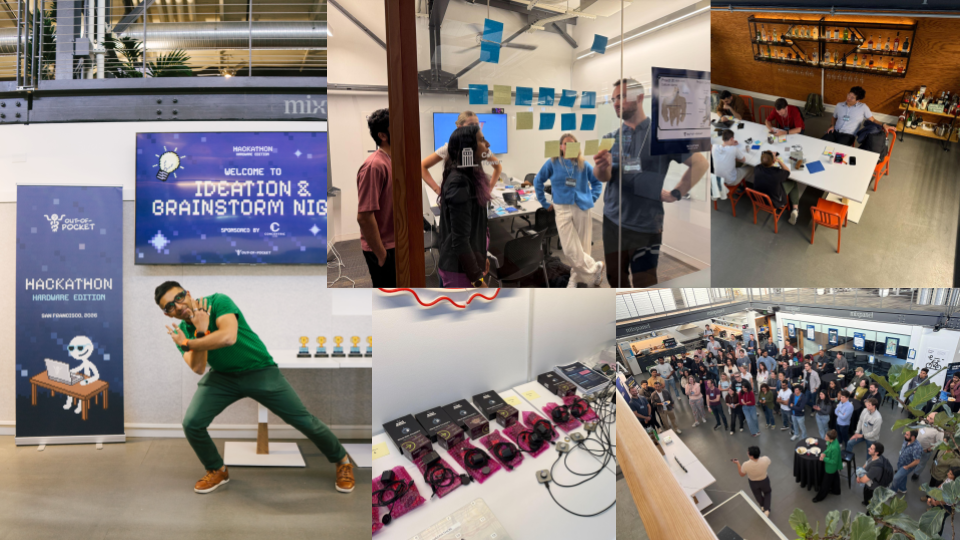
Did we solve healthcare in 36 hours with hardware?
A couple months ago we did a hardware hackathon in SF!! We gave 13 teams a whole buncha hardware…Oura rings, continuous glucose monitors, Meta raybans, Omi listening pins, and Samsung smartwatches. I brought this in a suitcase and had a very intimate moment with TSA.
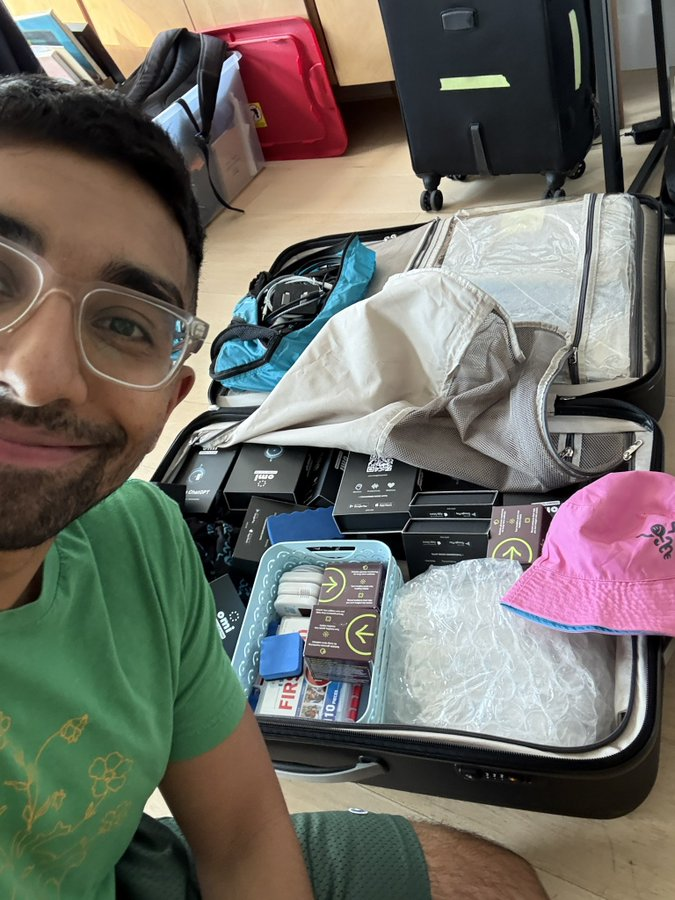
Then we gave hackers a bunch of Celsius and 36 hours to see what their sleep deprived brains could think of. And the results did NOT disappoint!! Below you’ll see 6 of the projects that came out, and part 2 will come out soon with the other 7. Sign up for the newsletter to see them all, and we’ll also be uploading the demos to YouTube.
And if you wanna chat about doing a custom hackathon on top of your companies product or at your company, email me back and we can chat.
A few musings after the hackathon.
- We had a lot of clinical representation! 10 people that were in some way clinical (pediatric ICU nurses, docs, PTs, etc.). Honestly one of my goals is to get the clinicians building with the tech themselves so they can understand what’s possible vs. not.
- The types of data you can get from hardware have increased substantially. Omi pins can capture the text data passively, the Samsung watch can do bioimpedance to check body composition, Meta glasses to take hands-free video and analyze it, etc.
- One natural part of hackathons is you will naturally start arguing with your team, who are essentially randos. It’s a good way to see how people deal with conflict resolution when they need to accomplish something in a short period of time. Personally I always thought hackathons could be an interesting format to use for job interviews because it tests someone in an actual working environment.
- Hackathons are also the perfect way to carve some time out to play around with new tools you don’t have time for in your day job. We train you, there are mentors, we have workshops, and you have peers to guide you. Honestly, more companies should do this regularly, we are happy to facilitate :)
- I was surprised and impressed by how many teams explored using local models for their projects. Either because of the awareness of how much more private wearable/video data is or because they were exploring low connectivity use cases.
I’ll give more musings in the next roundup of projects. On to (half) of the projects themselves! All projects were built from scratch with the hardware given in 36 hours. Reach out to teams if you find their projects interesting! It’s always really nice to hear from people on work you did.
TXA - Trauma Transfer Agent
[**Winner of People's Choice Award 3rd Place + Duct Tape Dynasty Award ]
Team Involved:
Abhinav Sriram - abhinav@sriram.email
Sonia Chahal - sonia.s.chahal1@gmail.com
Alexander Melton - alex@melton.io
Rohan Kotecha - rohan@curvlabs.io
Mishaal Ali - mishaalali100@gmail.com
Athena Yao - athenaayao@gmail.com
Detailed description:
TXA - Trauma Transfer Agent
Today's trauma handoff is a single phone call followed by silence. The receiving team gets a brief radio report, then waits while the patient's condition evolves in ways no one at the hospital can see. By the time the stretcher arrives, clinicians are rebuilding the story in real time, losing critical minutes in the process. In rural settings and air transport, the breakdown is worse: long transport times, spotty connectivity, and no reliable data link mean the most important information never makes it to the bay at all.
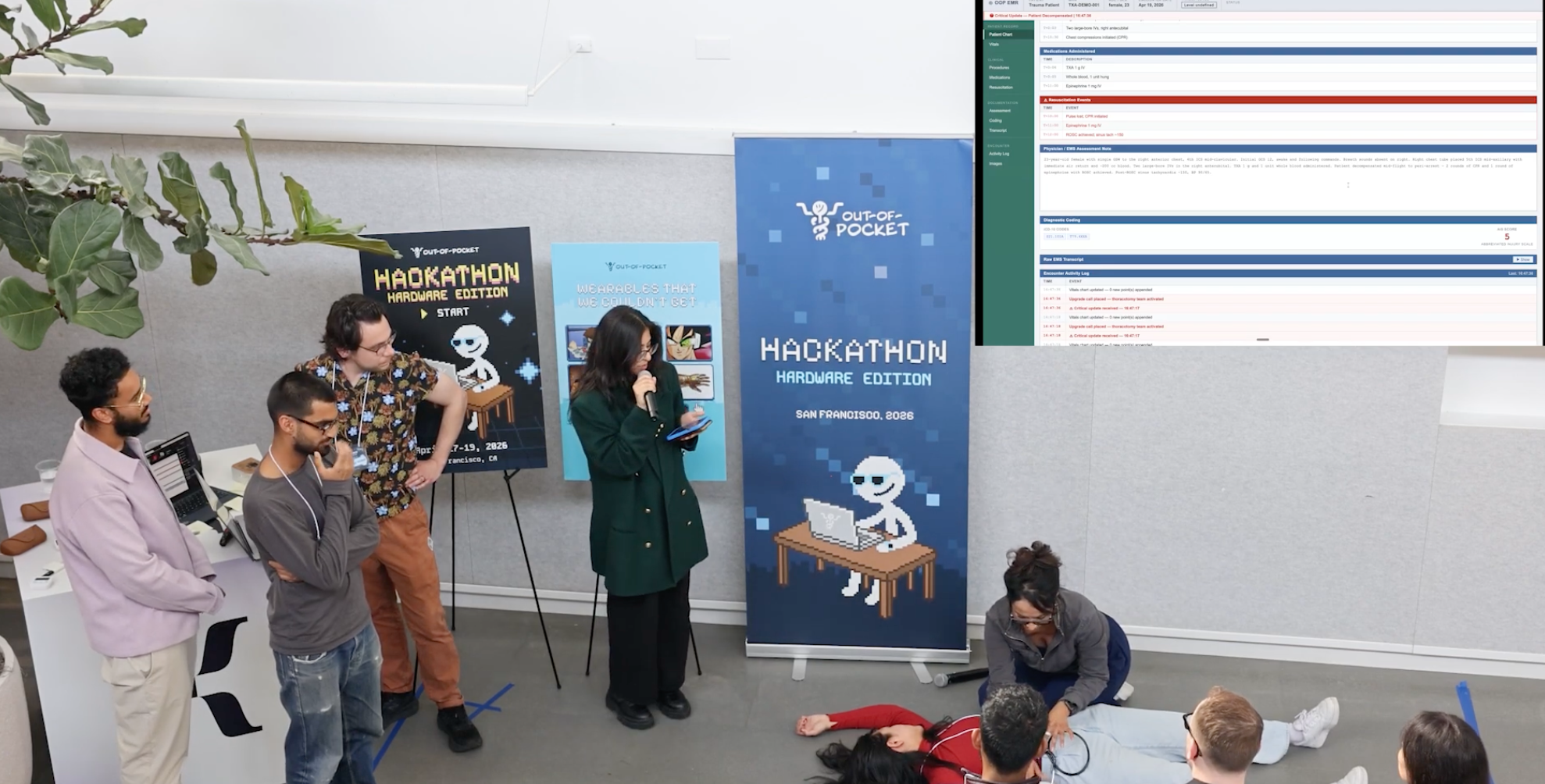
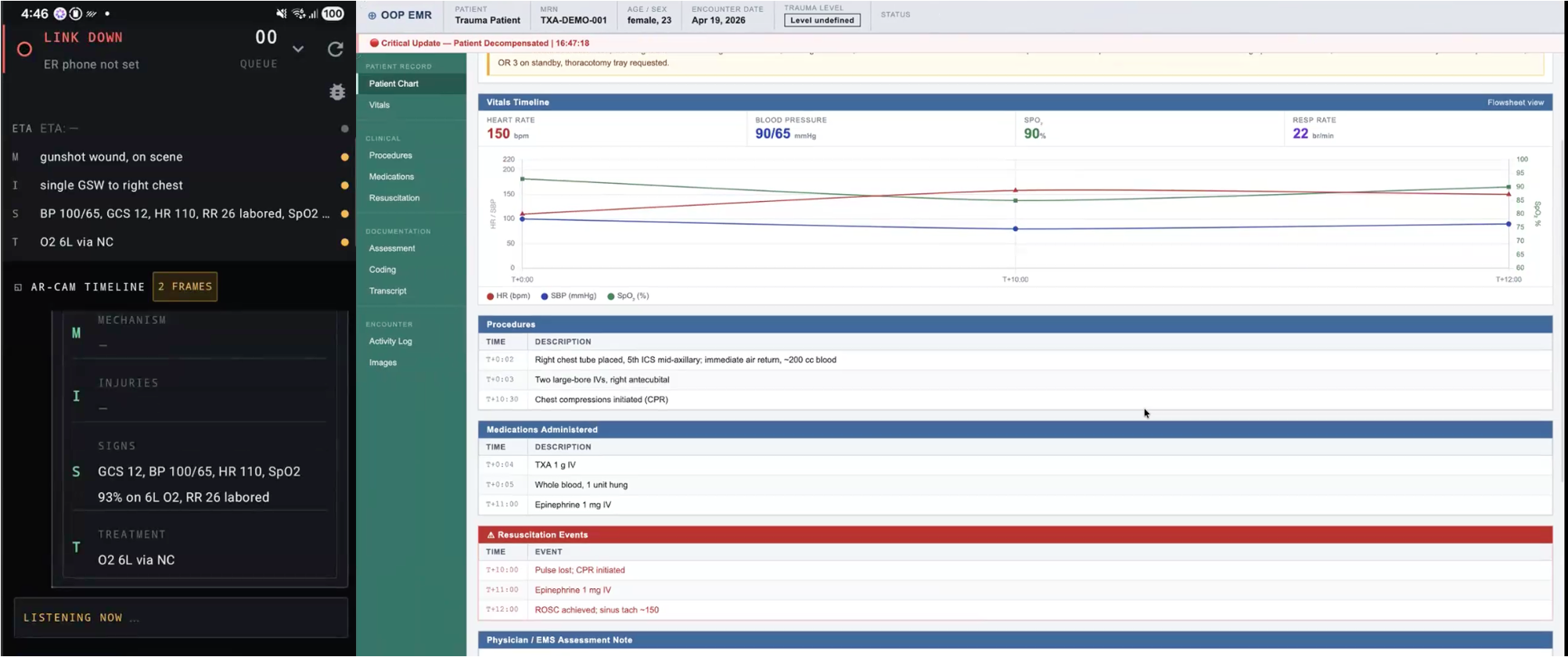
TXA turns that handoff into a continuous transfer of care. Running fully offline on a mobile device, TXA captures the field assessment through Meta smart glasses and Omi, structures it in real time using a clinical ontology-aware local Gemma 4 model, and streams continuous vitals from the Samsung Galaxy Watch and Oura Ring. The moment connectivity is restored — when the helicopter or vehicle enters range — TXA fires a structured voice call to the trauma bay and automatically populates the EHR with the full clinical encounter: vitals timeline, procedures, diagnoses, and notes. The result is a seamless field-to-hospital handoff: better context, earlier preparation, and faster, more informed care.
Hardware used: Meta glasses, Samsung phone and watch, Oura
Demo:
Watch the Live Demo
—
[NK note: And to think I’ve been transferring my trauma through self-deprecating memes like a luddite! This team really pushed for this project to run on a model offline and I told them that no one would even be able to tell.
I’m glad they told me to f*** off, because the project landed way better when you realize how many healthcare scenarios there are like this where you won’t have connectivity but AI tools can be really helpful. Now air ambulances can quickly give context and bill out-of-network!]
{{interlude 3}}
Lazarus - A copilot for CPR
[**Winner of People's Choice Award 2nd Place]
Team Involved:
Li Terry - lichen927@gmail.com
Yuan Zheng - yuanz.design@gmail.com
Sean Erickson - seanericksonpl12@gmail.com
Ryan Erickson - ryanjerickson680@gmail.com
Limu Xiao - limuxiao1928@gmail.com

Detailed description:
CPR training and real CPR are completely different experiences. When it's real, you're fatigued, under pressure, two minutes in — nobody is watching your hand position, nobody is telling you your rate drifted, nobody is telling you your depth dropped because your arms are giving out. You're performing the most time-critical intervention in medicine with zero feedback.
Lazarus is a CPR copilot on your wrist. It guides you through every live session with real-time voice and haptic feedback calibrated to AHA targets — then hands your session data to Claude for a personalized debrief that turns every attempt into a training opportunity.
Illustrative user experience:
A session starts with a tap on the Samsung Watch. Lazarus measures compression rate, depth, and recoil from the accelerometer and compares them against AHA targets in real time — coaching you with voice cues and haptic nudges when technique drifts. Too slow? You feel it and hear it instantly. Tap to end the session and Claude delivers a personalized debrief: key metrics, what held up, and one clear thing to fix next time.
Key features:
Watch app - quick tap to start and end session; live session key metrics; voice and haptic feedback
Phone app:
- Live session key metrics
- Analysis on key metrics and a quick action plan for improvement
Demo:
See The Live Demo
[NK Note: The watch really should started playing “Staying Alive” or “Not Like Us” to give the beats per minute. This team was the funniest to track through the hackathon because every few hours I’d check in on them and they’re still trying to resuscitate a teddy bear and whispering expletives.
But I think a feature like this can be a genuine lifesaver, and I actually hope more smart watches try including something like this as a feature. It’s also an impressive use of the accelerometer in the watch.]
……………………………………………………………………………………………………………………
Tamago - Checking in on new moms
Team Involved:
Varsha Devulapalli - varsha.devulapalli@gmail.com
Mehak Sharma - mehak.sharma@gmail.com
Minal Shah - Minal.shah@gmail.com
Detailed description:
Tamago is a postpartum intelligence app that monitors physiologic data through Oura and ambient audio through OMI to build a real-time picture of a new mother's recovery. When the signals turn, it calls in her village. Caregivers receive a clear, actionable brief: what's happening, and how to help right now.

The fourth trimester is the most medically under-supported period in a woman's life, and most wearable technology only talks to the person wearing it. Tamago routes the signal outward. By minimizing alerts to the mother and focusing instead on her support circle, Tamago transforms passive concern into coordinated care, closing the distance between data and the people ready to act on it.
Hardware used:
Oura Ring
Omi
Demo
See The Live Demo
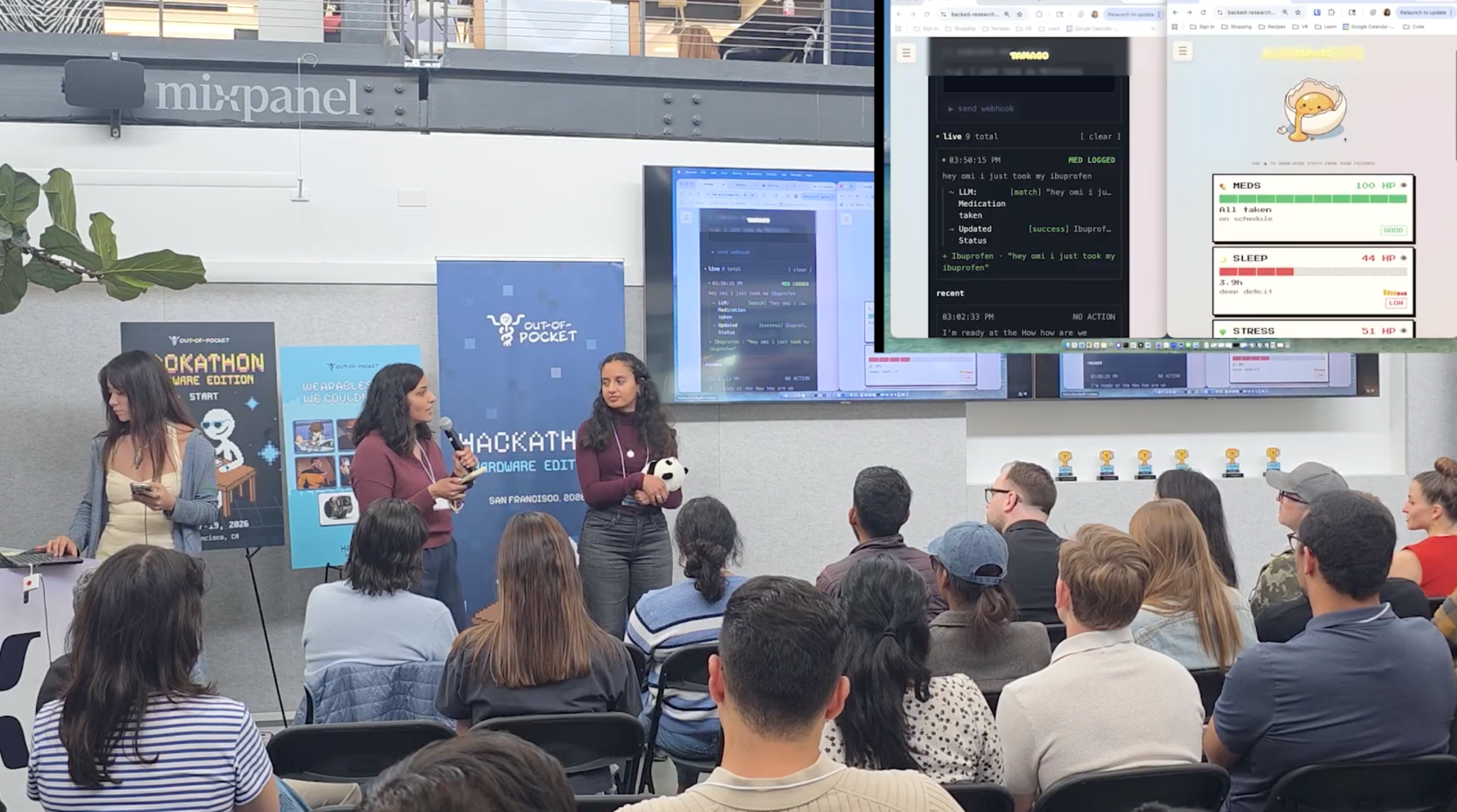
[NK Note: Honestly I thought this project should have gotten an award. And I’m not just saying that because I get to play the honorary role of “deadbeat dad” in the demo.
I’m in the phase of life where lots of people are having kids and those first few months are just brutal. It would have been great to have live status updates on how they were feeling so that close friends could reach out. I also thought they did a great job thinking through the fine line of privacy and monitoring.]
……………………………………………………………………………………………………………………
SteadyStep - Fall risk detection
Team Involved:
Detailed description:
SteadyStep: A safer home, one step at a time
One in four older adults falls every year, and more than half of those falls happen at home. Today’s solutions are reactive—they detect falls after they happen. We focus on preventing them before they occur.

In a single walkthrough, Meta Ray-Ban glasses stream first-person video to a system that reconstructs the home in 3D and identifies hazards like rugs, cords, low tables, loose grab bars, and poor lighting in real time. Claude then vets each detection against the scene to ensure accuracy before issuing live auditory warnings to the wearer.
In parallel, a Samsung Galaxy Watch captures accelerometer data to compute clinical gait metrics, allowing us to pinpoint where environmental hazards overlap with the wearer’s highest instability.
The output is a top-down floor plan with hazards pinned, numbered, and ranked by fall risk—combining both environmental and physiological signals from the same walk. The report is one tap away from sharing with a OT/PT or family member, along with suggested interventions to make the home safer and the wearer more independent in their own home.
Demo:
See The Live Demo
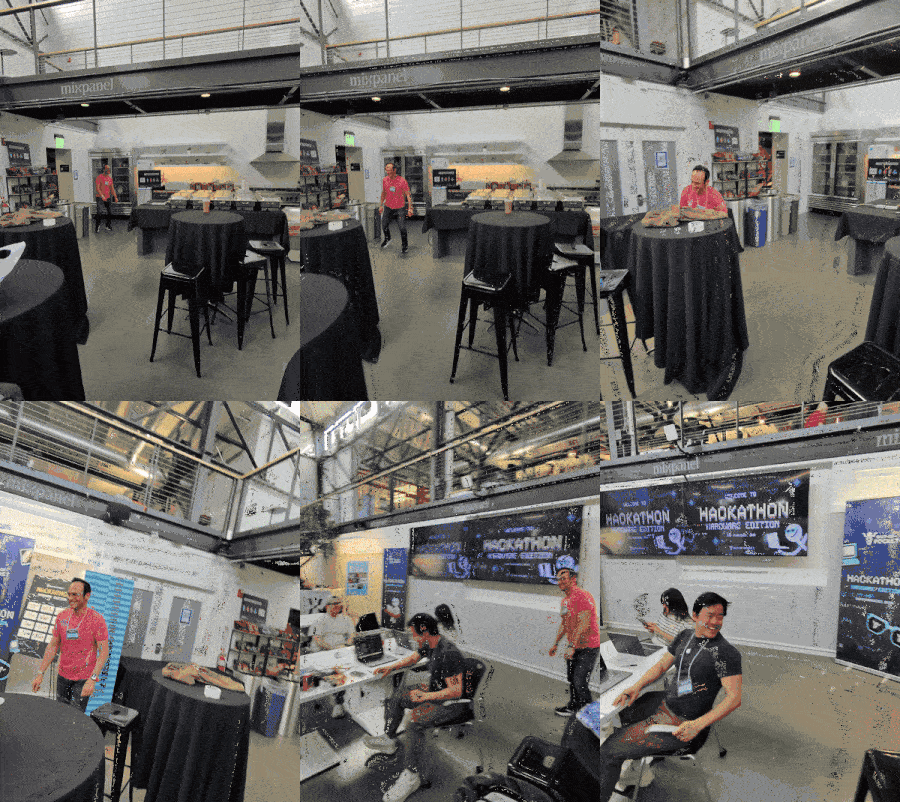
[NK note: This team needed to create gait data for someone who was about to fall. So throughout the hackathon you would just see a man who looks like he was absolutely SMACKED off some non-NA brews in the middle of the day.
Extremely technically impressive, I overheard this team talking about using some GPU farms in other countries and I decided not to ask any further questions. Really interesting use of the Meta Glasses to do passive tracking, but also shows how much more context data video creates that needs to be analyzed vs. picture/text.]
……………………………………………………………………………………………………………………
Eternal - One monitoring device for all ages
Team Involved:
Detailed description:
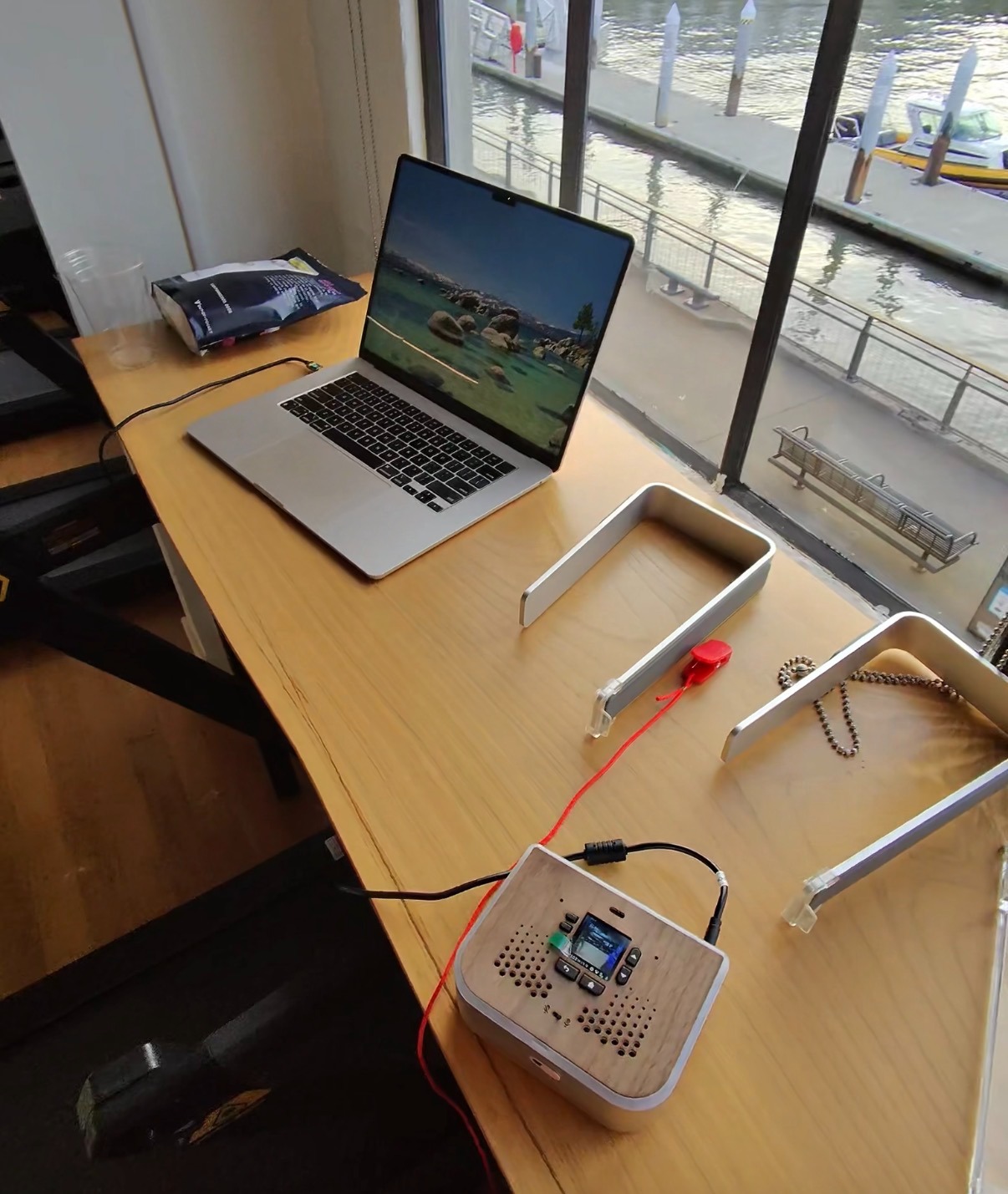
The Eternal Hub serves as a permanent, localized edge-computing base station, designed to overcome health technology fragmentation. It is an Open-Ecosystem Lifespan Health Hub, powered by the open source Ubo Pod (getubo.com). It achieves this by dynamically integrating with a user's third-party wearables and sensors throughout their entire life. Furthermore, the Hub is equipped to utilize healthcare aggregation services like b.well.
The Pod prioritizes privacy by processing sensitive data locally. It covers a timeline of health challenges, from monitoring infant risks like Apnea and Convulsions (ages 0-5 years) to providing Physical Therapy assistance (ages 15-65+ years) and extending to elder care for fall and daily activity detection (water intake, taking medication, etc.). The hackathon demo focuses on implementing three high-priority goals: fall detection for infants and elderly, physical therapy using Meta Ray-Ban and water intake monitoring for dementia patients.
Demo
See The Live Demo
[NK note: It’s pretty clear in the future you would want one piece of hardware to monitor a bunch of different use cases and adjust them based on the person. Which does present some interesting challenges around where you put the camera and how you create different identities and risk factors per person. I liked that the team thought about the fact that this would need to be an ever present monitoring device in your house, but the device has the ability to run the AI locally so you’re not just farming out a video feed overseas. Can’t have my brethren in India seeing how I cook their food.]
……………………………………………………………………………………………………………………
Hospitality Helper - Making the waiting room better
[**Winner of the “Damn Son Award” for most mind-blowing AI application]
Team Involved:
David Hardin - dmhardin102@gmail.com
Paulius Mui - paulius@xprimarycare.com
Misha Manulis - misha@xprimarycare.com
Ciaran Murphy - murphy.ciaran.n@gmail.com
Pranay Madan - madan.pranay@gmail.com
Yilun Zhang - zhangyilun1337@gmail.com

Detailed description:
Healthcare experience really sucks for patients and staff. NPS is abysmally low. We have overworked receptionists and anxious patients colliding in waiting rooms, running on bad sleep and low blood sugar. Nobody sees the detractor-in-the-making until the 1-star review lands weeks later.
Hospitality Helper turns wearable and ambient signals across patients and staff into a live predicted NPS and tailored coaching tips for healthcare teams that drive business growth. Oura rings, Samsung watches, Meta glasses, Omi mics, and CGMs feed a model that reads the room in real time, then quietly nudges the right staffer with the right move before a visit goes sideways. One NPS point is worth $1–3K per clinic per year, so feeling good is finally good business.
Demo:
See the live demo
—
[NK note: This one was very funny lol. Extremely impressive live demo! A few things this made me think about:
- There probably will be a time where workplaces will ask if you want to share your wearable data with them.
- This will ruin the “give the front desk doughnuts” b2b sales tactic
- There’s a fine line in hospitality between “wow they predicted exactly what I want” and “it’s pretty creepy that they did this”
- There’s already an implicit thing companies do around serving annoyed customers first so they don’t make it worse for other customers, but I think codifying it would basically make people game this system
- It would be awesome to have a way for patients to just share passively how long they’ve been in the waiting room. Like Waze for physical spaces.]
Parting Thoughts
Reminder, 7 more projects that were built are coming out soon! Sign up for the newsletter to get them + YouTube channel will have them soon. And if this seems like something you’d want to come to in the future, you should sign up for the next one (which will be in NY this fall).
A huge shoutout to our sponsors. This would not have been possible without sponsors that understand our ethos around getting INVOLVED in our events. Let’s chat if you want to be involved in the next one or do a custom on.
Samsung Health - Powered by advanced AI and smart devices, Samsung Health helps individuals take control of their wellness by integrating exercise, nutrition, sleep and mindfulness. With personalized, data-driven insights, Samsung Health empowers people to make sustainable lifestyle changes and achieve better long-term health outcomes.
b.well Connected Health - b.well Connected Health is a pioneering healthcare software company that empowers individuals to take control of their health journey. Our platform integrates health data, provides personalized insights, and connects users with healthcare providers and wearables, all in one seamless experience, to promote better health outcomes and simplify healthcare management. We standardize all the data into FHIR and provide a simple FHIR API and AI SDK to access that data.
Open Wearables - What if wearable health data were actually open? Open Wearables is the open-source platform that makes it real: one API for device data, transparent scoring algorithms, and an AI reasoning layer so any LLM can work with health intelligence. Self-hosted. Free to use. 5 minutes to set up.
Xmartlabs - Xmartlabs is a product and engineering partner that helps healthcare teams design, build, and scale complex digital products. At the hackathon, Xmartlabs supported builders with practical wearable-data tools - including VytalLink and React Native Health Link - to help teams prototype faster with real health data.
Alyf - Alyf is building the infrastructure for chronic disease management, starting with cardiology. Alyf turns continuous data from hundreds of devices into clinical intelligence - deployed across 3 states and multiple health systems, with first-in-human heart failure outcomes presented at THT 2026. The body tells a story - Alyf translates it into care.
Medplum - Medplum is an open source project, community and company that helps customers build custom medical apps, like custom EHRs, copilots, agents and scribes. Star our repository!
Concentric Labs - Concentric Labs is building the infrastructure to close the gap between what science is capable of and what patients can access. Our platform accelerates the development of life-changing therapies by working directly with scientists behind them to help them get regulatory approval, automate paperwork that takes them away from science, find ways to fund their research, and bring transformative treatments to meet patients where they are.
SUNA - SUNA is a smart wearable for gut health and nutrition.
Vanta - No matter your size, Vanta helps you automate compliance, manage risk, and prove trust continuously—all from a single, agentic platform.
Thinkboi out,
Nikhil aka. “Metapod used Hardware” aka. “Microdosing Tony Stark”
Twitter: @nikillinit
IG: @outofpockethealth
Other posts: outofpocket.health/posts
If you’re enjoying the newsletter, do me a solid and shoot this over to a friend or healthcare slack channel and tell them to sign up. The line between unemployment and founder of a startup is traction and whether your parents believe you have a job.
Quick Interlude - “Am I a fit for Knowledgefest?”
See All Courses →Based on the questions I’m getting about Knowledgefest, I’m doing a really bad job explaining who should come.
The conference is for anyone building in healthcare.
- It is not specific to companies delivering patient care - Lots of people at software only, insurance, etc are coming.
- Any size of company can come - We have two person just out of YC companies, people that run ops at clinics, to F500 companies.
- You can be any role - Almost every role touches ops in some way. Product, founders, clinical, etc. should definitely come.
You should apply if you’re not sure, and we’ll let you know :)
Get Out-Of-Pocket in your email