Fine, let’s talk about peptides
Get Out-Of-Pocket in your email
Looking to hire the best talent in healthcare? Check out the OOP Talent Collective - where vetted candidates are looking for their next gig. Learn more here or check it out yourself.
 Hire from the Out-Of-Pocket talent collective
Healthcare 101 Crash Course
%2520(1).gif)
Featured Jobs
Finance Associate - Spark Advisors
- Spark Advisors helps seniors enroll in Medicare and understand their benefits by monitoring coverage, figuring out the right benefits, and deal with insurance issues. They're hiring a finance associate.
- firsthand is building technology and services to dramatically change the lives of those with serious mental illness who have fallen through the gaps in the safety net. They are hiring a data engineer to build first of its kind infrastructure to empower their peer-led care team.
- J2 Health brings together best in class data and purpose built software to enable healthcare organizations to optimize provider network performance. They're hiring a data scientist.
Looking for a job in health tech? Check out the other awesome healthcare jobs on the job board + give your preferences to get alerted to new postings.
Injecting a cold one with the boys
The other day I was hanging out with a friend, and he casually mentioned that he’d been taking BPC-157 for his shoulder pain. It was a pretty weird way to respond to “how’s it going?”. Even more surprising, he told me that one of the older uncles told him about it after doing it himself for knee pain. (South Asian “uncle”, not biological ya mean).
BPC-157 is one of many products, colloquially called “peptides”, that people are taking . This bucket basically comprises drugs that are short amino acid chains and not FDA-approved for the disease people are using them for (or approved at all). They’re generally sold through a lot of “hint hint wink wink” channels like compounding pharmacies, telehealth clinics, or "research chemical" vendors tell you not to use them for human consumption. Like yeah dude, a horse lives at this address just put the powders in the bag bro.

The White House is also relaxing some of the regulations on certain peptides, though tbh I’m confused what it actually means in practice and seems to be evolving. Either way it’s clearly gaining momentum.
I think peptides have created some interesting debates online, but I figured this group of readers might actually have some diverse/nuanced perspectives on this. So today I want to know what are your thoughts on the peptide boom that’s currently happening? I’ll put my favorite responses in the next newsletter (will keep anonymous if you want).
[For the purposes of this post, we’re mostly talking about peptides that have not been approved vs. getting cheaper access to the active ingredients of approved drugs like Wegovy. These are very different things, but have some overlap like supply chain issues]
{{interlude 3}}
Do peptides work? Risks? Who’s even checking?
There’s a few issues with peptides. For example, tracking where the materials for peptides come from, is it even the potency they say, are people injecting themselves correctly, etc. All of these are basically done via telegram, discord, and shady supplier sites. In 2020 people were hoarding toilet paper, in 2026 they’re hoarding bacteriostatic water (needed to safely mix with peptide powder).
Here’s an interesting preprint paper that came out which tested 6K+ samples of gray market peptides. 41.6% to 71.1% of gray-market peptide samples failed basic quality criteria for purity and dose accuracy. 2.4% of samples didn't even contain the stated peptide at all!!!

The other issue with peptides is it’s hard to tell if they’re doing anything. Many peptides either went through some parts of the clinical trial process and stopped, or never went through it at all. I tried looking for data about how some of these peptides perform, and almost all of them are done in animal models and very few have any human data. Even the ones with human data were either not randomized, only look at tolerance of the drug/if it increased a surrogate marker and not if ithelped with the underlying issue, or were in tiny tiny sample sizes.
In short, it’s really hard to tell if the drugs are working against some clinical endpoint. This not only makes it hard to tell what’s snake oil, but also makes it hard to assess the risk vs. benefits because we don’t really understand the benefits.

But what’s particularly bad here is that because of how gray market all of the peptide sourcing and administration is, there isn’t really an entity monitoring the long term issues here. One big concern is whether these unregulated peptides are introducing higher cancer risks in people taking them (turns out the mechanism that helps muscles regrow might also cause cells to grow too much).
There is currently no entity whose job is to actively monitor the risks of taking these peptides. This is both the short term risk (active ingredient, packaging, storage, etc.) and the long-term risk (are these people going infertile, getting cancer, etc.).
it’s basically happening entirely hearsay on forums/discord/encrypted chat. In fact, because every part of the supply chain is making money from the consumption of more peptides they are very actively disincentivized from collecting that data.
Even if you scrape the subreddit, you’re only getting info from people willing to post and without a lot of context data about the rest of their health/what they’re actually doing since they’re self-administering. Most people report no side effects or issues on these drugs, which could be great! But those are only the people who are replying.

On top of that, many people are taking normal pharmaceutical products that are being prescribed to them and we have no idea how those drugs are interacting with these peptides since they’re happening in totally parallel systems!
We essentially have no idea what’s going on with the people taking these gray market drugs.
It’s all about the unit economics
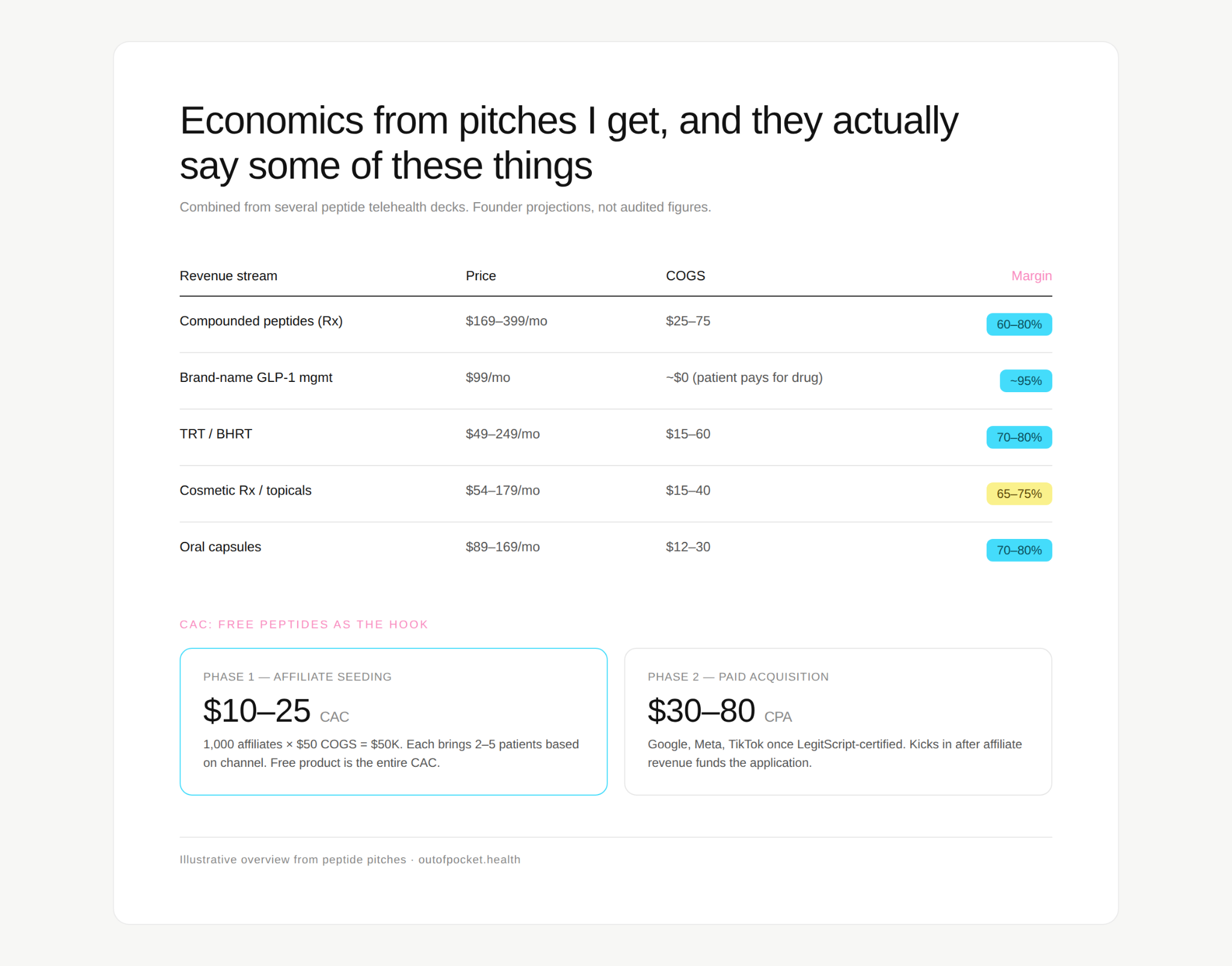
I get so many pitch decks now for peptide companies now and basically all of them:
- Exclusively focus on their customer acquisition costs, their user generated content/video content including AI generated marketing pipelines, and affiliate marketing strategy
- Talk about how fast their turnaround time is to patients and how broad their catalog of peptides are
- Do not talk at all about monitoring patients post prescription
- They all say they work with the top suppliers to provide legitimacy but don't really have a clear methodology for how they're doing this (esp with so many steps between securing the in ingredient, to shipping, to compounding)
It’s pretty clear that 90% of the companies that are operating in this space are starting with unit economics first. Hilariously, they might be the only healthcare companies to ever do this. They see this as an easy customer acquisition channel via influencer marketing + affiliates (which has very little oversight) and a product that has a very low cost of goods to create.
This is essentially the dropshipping strategy brought to healthcare, and in fact most of the founder profiles I’ve seen for these kinds of companies come from e-commerce or marketing. Not every peptide pitch is like this, I also get some for testing purity/supply chain monitoring/building out real-world evidence pipelines.
But the majority are working through this from the economics backwards, and it’s why even so many of the longevity companies will steer you to a peptide instead of a statin.
Which to me, doesn’t feel like a direction we necessarily want healthcare to be heading. Which is interesting because a lot of the peptide community will say things about how:
- Healthcare “puts profits over people” and wants you to keep coming back
- The doctors are getting paid by pharma
- “We have a sick care system, not a healthcare system”, a big brain line that sounds good but doesn’t really mean much.
I hope the irony is not lost on them that the peptide companiescompanies that are much more extreme about profit motivation, utilizing kickbacks, and not monitoring how patients are doing.
What the rise in peptides reveals
While the medical establishment likes to just dunk on things like this, it’s worth understanding why peptides are trendy right now. IMO it’s a confluence of a few things.
The easiest one to explain is that people want faster access to drugs they‘ve heard work but don’t want to wait for the clinical trials to prove it. Retatrutide is a good example of this.
But certain health issues where there isn’t much on the market that can help a person. Pain is one example of this - if nothing else has worked and someone is telling you BPC-157 cured them, then often the individual will see the benefits outweighing the risks.

Beyond that people want improvements in their quality of life or productivity in areas that these products claim they can help. These are areas where drugs typically aren’t prescribed or covered for “healthy” people, so they’re looking for the cheapest and easily accessible option that doesn’t require a doctor to prescribe this. Focus, longevity, muscle growth, etc.
In general there are a lot of patients that want more agency in their healthcare decision making and want to be able to assess risk themselves vs. relying on the government to do it for them.
Personal thoughts and ideological questions
When I walk around SF, I can’t tell if the person injecting themselves is doing drugs, Ozempic, or CJC-1295. Personally, I think if you’re relatively young and healthy then the risks outweigh the rewards here. But I’m also not your mom, you are grown adults making your own decisions.
There are a few questions this whole thing has made me wonder though.
- Should we basically expand right-to-try laws? If a company has demonstrated some level of safety in humans, should people be allowed to take on the risks themselves/pay cash to have access to the drugs under the supervision of a provider and submitting their data to a registry. Pharma will not love this, especially if they’re running the drug in actual trials in tandem. But this is effectively setting up the peptide version of safe injection sites and will allow us to monitor patients doing this anyway.
- Should we have shorter wellness peptide approval paths? One issue here is the binary “you’re a supplement with 0 oversight” or “you’re a drug with an enormous regulatory burden”. We probably need something that’s in between - demonstrate safety, have oversight into manufacturing, and monitors real-world evidence to see what should be pulled from the market. This seems to be where this administration is directionally headed.
- What does this mean for pharma going forward? If any drug they bring to market is basically going to have an underground cheap peptide version come out, it erodes your ability to recoup the cost of bringing that drug to market. It’s one thing for peptides to be used for drugs that would never be developed, but getting access to retatrutide is basically designed to subvert the pharma patent process.
- What is the demographic breakdown of peptides? When I look on Instagram it’s a pretty wide array of people that use them. But one thing that particularly worries me is seeing videos like this where really young people (teenagers!) are able to access these drugs since it’s all gray market and there’s no verification of the buyers. I remember what it was like being 16 and feeling very scrawny as all South Asian teens do. I’m glad things like this didn’t really exist when I was growing up because I could have definitely gotten caught in this vortex. I think regular peptide users would probably agree we should have some age limits on who’s allowed to access these things.

- Why are the peptide people so mean? You say one thing online that’s bad about peptides and a bunch of people with bodybuilding avatars will comment about how skinny you are. I already know this post is going to get torn apart by both the physician and peptide communities.
So tell me what you think about peptides? Would especially love to hear from people that actively take them or disagree with my framing. I’ll keep it anonymous if you’d like.
Despite all my jabs (no pun intended), I am open to hearing counterpoints to this and changing my mind!
[I thought Grant Hesser’s post about this was a good encapsulation of this trend with some slightly different angles to it].
Thinkboi out,
Nikhil aka. “Got that pep in my step” aka. “Is it a peptide name? Or an ICD code?”
Thanks to Malay Gandhi and Adu Subramanian for reading drafts of this
Twitter: @nikillinit
IG: @outofpockethealth
Other posts: outofpocket.health/posts
If you’re enjoying the newsletter, do me a solid and shoot this over to a friend or healthcare slack channel and tell them to sign up. The line between unemployment and founder of a startup is traction and whether your parents believe you have a job.
Quick Interlude - “Am I a fit for Knowledgefest?”
See All Courses →Based on the questions I’m getting about Knowledgefest, I’m doing a really bad job explaining who should come.
The conference is for anyone building in healthcare.
- It is not specific to companies delivering patient care - Lots of people at software only, insurance, etc are coming.
- Any size of company can come - We have two person just out of YC companies, people that run ops at clinics, to F500 companies.
- You can be any role - Almost every role touches ops in some way. Product, founders, clinical, etc. should definitely come.
You should apply if you’re not sure, and we’ll let you know :)

Get Out-Of-Pocket in your email